What Elements Are Foundational for SEO with AI: A Complete Guide

Most websites are still doing SEO the 2018 way — and wondering why traffic is dying. AI changed how search engines read, rank, and reward content, and if you don’t understand the new rules, you’re optimizing for a game that no longer exists.
What Is AI SEO?
AI SEO is the practice of optimizing your content for search engines that use artificial intelligence — like Google’s Search Generative Experience — to understand meaning, not just keywords.
It means your content must satisfy intent, demonstrate expertise, and connect ideas in a way machines can actually understand.
The core elements are: search intent, topical authority, content depth, entity optimization, internal linking, technical SEO, E-E-A-T, structured data, UX signals, and content freshness.
Why Everything You Knew About SEO Just Changed
Old SEO was simple: find a keyword, use it 10 times, get a backlink, rank.
That model is dead.
Google’s AI — built on models like BERT and MUM — doesn’t just match words. It understands what a user actually wants when they search.
Here’s the difference in real terms.
Old SEO saw the query “best protein powder” and ranked pages that contained those exact words the most. AI-powered search understands the user probably wants a comparison, wants to know about ingredients, is likely a fitness beginner, and wants something affordable — none of which were in the original query.
The shift from keyword matching to intent satisfaction is the single biggest change in modern SEO.
If your content still opens with “In this article, we will discuss protein powder,” you’re losing to someone who opened with “Here’s what no one tells you about picking a protein powder that actually works.”
That’s the gap. Now let’s close it.
3. Core Foundations of AI-Era SEO
3.1 Search Intent: The One Thing You Must Get Right Before Writing a Word
Here’s where most writers fail before they even open a Google Doc.
They pick a keyword. They don’t ask why someone is searching for it.
Search intent is the real reason behind a query.
Google categorizes it into four types.
Informational — the user wants to learn something.
Navigational — they’re looking for a specific site.
Commercial — they’re comparing options before buying.
Transactional — they’re ready to buy right now.
Same topic. Different intent. Completely different content.
“How does SEO work” = informational. Your content needs to teach.
“Best SEO tools” = commercial. Your content needs to compare.
“Buy SEMrush plan” = transactional. Your page needs to convert.
“Ahrefs login” = navigational. Don’t even try to rank for it.
To identify intent, type your keyword into Google and look at the top 10 results.
Are they blog posts? Product pages? Videos? Comparison articles?
That’s Google telling you exactly what format satisfies this query.
If your format doesn’t match the dominant intent, you will not rank — no matter how good the writing is.
Match the intent first. Write second.
3.2 Topical Authority: How to Make Google Trust Your Entire Website
Ranking one article is temporary. Ranking your whole site consistently — that’s topical authority.
Topical authority means Google recognizes your site as a trusted, comprehensive source on a specific subject. It’s not about having one great page. It’s about having interconnected pages that cover a topic more thoroughly than anyone else.
The structure that builds this is called pillar and cluster.
A pillar page is your main, broad-topic page.
“Complete Guide to SEO” is a pillar.
Cluster pages are specific, deep-dive articles that support it.
“How to Do Keyword Research,” “What is On-Page SEO,” “Technical SEO Checklist” — all clusters.
Every cluster links back to the pillar. The pillar links out to every cluster.
Here’s a real example. Say your niche is personal finance.
Your pillar: “Complete Guide to Saving Money.”
Your clusters: “How to Build an Emergency Fund in 90 Days,” “The 50/30/20 Budget Rule Explained,” “Best High-Yield Savings Accounts 2025,” “How to Cut Monthly Expenses Without Feeling Broke.”
Each cluster article signals to Google: this site knows personal finance deeply — not just surface-level.
When you publish a new cluster article, Google doesn’t just rank that page. It reassesses your entire site’s authority in that topic. That’s the compounding effect most blogs miss.
Start with one pillar. Build 8 to 12 clusters around it. Link them all together. Repeat for the next topic.
3.3 Content Depth: The Difference Between “Covering a Topic” and “Owning It”
“Quality content” is the most repeated, least explained phrase in SEO.
Here’s what it actually means: your content is high quality if it answers every question a reader has about that topic, in the right order, with enough detail that they don’t need to go anywhere else.
Shallow content tells you what.
Deep content tells you what, why, how, when, and what to do when it doesn’t work.
Real example of shallow: “You should do keyword research before writing. Use tools like Ahrefs or SEMrush to find keywords.”
Real example of deep: “Before writing a single word, search your primary keyword in Ahrefs. Filter for keywords with a Keyword Difficulty below 30 and monthly search volume above 500. Then check the top-ranking pages — if they’re all from domain authority 70+ sites, skip it. Find the same intent with a longer-tail variation you can actually compete for.”
Same topic. The second one is something you can act on today.
Depth is not length. A 500-word article can be deeper than a 3,000-word article if every sentence solves a real problem.
Audit your existing content with this test: after reading your article, does the reader have everything they need to take the next step? If not, that’s a gap. Fill it.
3.4 Entity-Based Optimization: How AI Actually Reads Your Content
Google doesn’t just read words. It reads entities — real-world concepts, people, places, products, and ideas — and maps the relationships between them.
An entity is anything that can be distinctly identified. “SEO” is an entity. “Google” is an entity. “Backlink” is an entity. “Neil Patel” is an entity.
When Google’s AI reads your page, it’s not counting how many times you wrote “SEO tips.” It’s asking: does this page correctly connect the entity “SEO” to the related entities of “keywords,” “backlinks,” “search intent,” “Google algorithm,” and “content strategy”? Does it show that this author understands how these concepts relate to each other?
Here’s a simple entity map for a technical SEO article.
Core entity: Technical SEO.
Related entities it should mention: crawlability, indexing, Core Web Vitals, XML sitemap, robots.txt, canonical tags, structured data, page speed, mobile-first indexing.
If your article about technical SEO doesn’t mention most of those terms in context, Google’s AI sees it as incomplete — even if it’s well-written.
Use Google’s “People Also Ask” and “Related Searches” sections to find the entities your article must include.
These aren’t just keywords. They’re the connected concepts that tell AI your content is comprehensive.
3.5 Internal Linking: The Hidden Architecture Most Blogs Ignore
Your internal linking structure is your site’s nervous system.
It tells Google which pages are most important, how topics are connected, and where to send authority. Most blogs treat internal linking as an afterthought — they add one or two links at the bottom of an article and move on.
That’s a missed opportunity worth thousands of organic visits per month.
Contextual linking is the right way to do it. When you mention a concept in your content, link to the page on your site that covers that concept in depth. Don’t just link at the end. Link within the sentence where the concept appears, because that’s where context lives.
Hub pages — your pillar pages — should receive the most internal links. Every cluster article should link back to its pillar at least once. New articles should link to at least 3 to 5 older relevant articles. Older articles should be updated to link to new ones.
The most common mistake: writing 50 articles and never going back to add internal links to new content from old pages. That means your new page has zero internal authority from day one.
Every time you publish a new article, spend 15 minutes updating 3 to 5 older articles to include a contextual link to the new one.
This alone can lift new content rankings by 20 to 30% faster than without it.
3.6 Technical SEO: The Floor Your Content Sits On
Great content on a broken site goes nowhere.
Technical SEO is not glamorous, but it is non-negotiable. If Google can’t crawl your page, it won’t index it. If it can’t index it, it won’t rank it. No amount of great writing fixes a crawl error.
Three things you must have right.
Crawlability: Go to Google Search Console right now. Open the Coverage report. Fix every page with a “crawl anomaly” or “redirect error” label. Submit your XML sitemap to Search Console if you haven’t already.
Indexing: Check whether your important pages are actually indexed by searching “site:yourdomain.com/your-page-slug” in Google. If the page doesn’t appear, inspect the URL in Search Console and request indexing.
Page speed: A one-second delay in load time reduces conversions by 7%, according to research from Akamai. Use Google’s PageSpeed Insights. Get your mobile score above 70. Compress images. Remove unused plugins. Use a CDN.
These three fixes take a weekend. Ignoring them costs you rankings every day.
3.7 E-E-A-T: Proving You Actually Know What You’re Talking About
Google’s quality guidelines judge content on four things: Experience, Expertise, Authoritativeness, and Trustworthiness.
This matters more than ever because AI-generated content flooded the internet with confident-sounding text written by no one with any experience. Google is actively trying to surface content from people who have actually done the thing they’re writing about.
Showing experience means including real results. If you’re writing about SEO, show a screenshot of your traffic growth. Show the actual keywords you ranked for. Share a case study where you went from 200 to 12,000 monthly visits and what you did to get there.
Showing expertise means being specific in ways that only practitioners are. Anyone can write “use long-tail keywords.” Someone with expertise writes “target keywords between 800 and 2,000 monthly searches with a Keyword Difficulty below 25 — that’s your fastest path to page one in a new niche.”
Authoritativeness is built through backlinks from recognized sites, mentions in reputable publications, and a clear author bio that lists credentials and relevant experience.
Add a detailed author bio to every article — full name, photo, credentials, links to social proof — because Google explicitly uses this to evaluate content quality.
Trust is built through HTTPS, a clear privacy policy, accurate contact information, and no deceptive practices on your site.
3.8 Structured Data: Speaking the Language of AI Directly
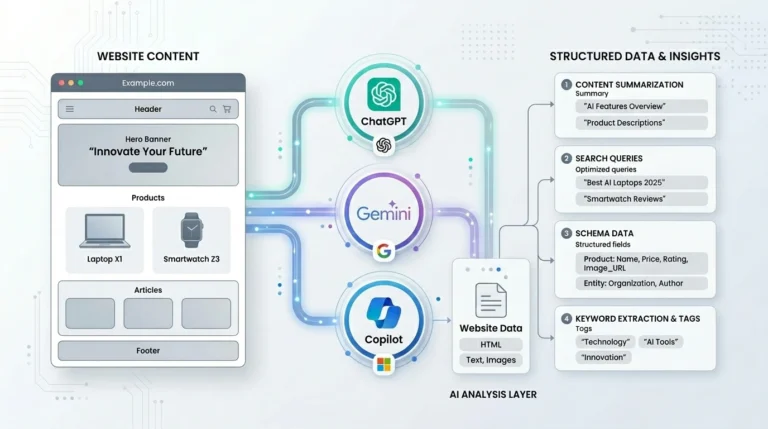
Structured data — also called schema markup — is code you add to your pages that tells AI exactly what your content contains.
Without it, Google has to guess. With it, you’re handing Google a labeled map.
Why does this matter?
Because AI-powered search features — featured snippets, knowledge panels, FAQ dropdowns, star ratings in search results — all pull from structured data. If you don’t have schema, you’re invisible in those features.
The key schema types you need:
Article schema for blog posts. FAQPage schema for any FAQ section. HowTo schema for step-by-step guides. Product schema for product pages. Review schema for testimonials and reviews. BreadcrumbList schema for site navigation.
FAQPage schema alone can double your search result real estate by adding expandable questions directly under your listing.
Use Google’s free Rich Results Test tool to validate your schema before publishing. Most WordPress SEO plugins like Rank Math or Yoast handle the basics automatically — just make sure they’re configured correctly.
3.9 UX and Engagement Signals: The Proof That Your Content Delivers
Google watches what users do after they land on your page.
If they leave in 8 seconds, that’s a signal your content didn’t match what they wanted. If they stay for 4 minutes, scroll through, and click to another page on your site — that’s a strong signal your content delivered value.
Dwell time is how long someone stays on your page after clicking from search.
Higher dwell time = stronger relevance signal.
To increase it, put your most valuable insight in the first 150 words, not buried in paragraph 12.
Use subheadings every 200 to 300 words so readers can navigate and stay engaged.
Bounce rate by itself is a weak signal — someone reading a recipe, cooking it, and leaving is fine. But a high bounce rate combined with short dwell time on an informational article is a problem.
Readability directly impacts both. Write at a Grade 7 to 8 reading level for general audiences.
Use tools like Hemingway App. Short sentences. Short paragraphs. Bold the key insight in each section.
The average reader decides in 3 seconds whether to stay or leave — your headline, sub-headline, and first two sentences are the only things that matter in that moment.
Make them count.
3.10 Content Freshness: When to Update and Exactly What to Change
Google rewards content that stays accurate.
For evergreen topics, update articles every 6 to 12 months. For fast-moving topics — AI, tech, finance, health — every 3 to 4 months. You don’t need to rewrite. You need to refresh.
Here’s what to update when you revisit an article. Check every statistic and replace outdated ones with current data. Add any new developments in the topic that happened since original publication. Update internal links to include newer related content. Revise the title to include the current year if it’s a comparison or guide. Update the published date in your CMS to reflect the revision.
One real example of the impact: a marketing agency updated 40 outdated blog posts — no new posts, just refreshes — and saw a 35% increase in organic traffic within 60 days.
Create a content calendar that schedules a monthly “refresh week” where you update 4 to 6 older articles instead of always creating new ones.
Your existing content is an asset. Treat it like one.
How AI Actually Evaluates Your Content
Understanding this changes how you write everything.
Google’s AI doesn’t read your article like a human does. It processes it in layers.
Layer one is relevance
Does the page match the query’s intent? Does it contain the right entities? Does the structure signal it’s the format type users want for this query?
Layer two is authority
Who wrote this? What sites link to it? Is the domain trusted in this topic area? How does this page’s internal link equity compare to competitors?
Layer three is usefulness
Did users who clicked on this page stay? Did they find what they were looking for? Did they click to learn more, or did they bounce back to Google?
Your content must pass all three layers — relevance, authority, and usefulness — to reach page one and stay there.
Most content fails at layer one by ignoring intent. Surviving content fails at layer three by giving shallow answers. Build for all three from the first draft.
Common Mistakes That Are Quietly Killing Your Rankings
You can fix all of these this week.
Writing for keywords only means your article is stuffed with the phrase “best email marketing tools” 14 times but never actually explains why one tool beats another in a specific use case. Google sees hollow intent-matching. Real readers bounce immediately.
No internal linking means every article you publish starts with zero authority from your own site. You’re leaving free ranking power sitting on the table with every post.
Thin content — articles under 800 words on complex topics — signals to Google that you haven’t fully explored the subject. If competitors are ranking with 2,500-word deep dives, your 600-word overview is not competing. Match or exceed the depth of what’s already ranking.
Ignoring entities means your article on “email marketing” doesn’t mention “open rates,” “segmentation,” “automation,” “deliverability,” or “A/B testing.” Google’s AI sees an incomplete picture of the topic and ranks a more thorough page instead.
The single fastest fix: take your three highest-traffic articles, open them right now, and add internal links to five related pages on your site that you’ve never linked to from them.
Do that today. You’ll see movement within 30 days.
Practical Workflow: How to Execute This From Start to Publish
Here’s the exact process to follow for every piece of content you create.
Step 1: Pick the topic.
Choose a topic that fits inside your existing pillar-cluster structure, or one that will anchor a new pillar. Don’t publish orphan content that doesn’t connect to anything else on your site.
Step 2: Map the intent
Search the keyword in Google. Read the top 5 results. Identify whether the intent is informational, commercial, or transactional. Match your format to what’s already ranking.
Step 3: Create the cluster plan
Before writing your main article, list 6 to 10 related subtopics that should eventually become cluster articles. This prevents you from writing something isolated.
Step 4: Write the content
Lead with your most valuable insight. Cover every entity connected to the topic. Match the depth of what’s ranking. Use short paragraphs, bold key insights, and subheadings every 250 words.
Step 5: Add internal links
Before publishing, add contextual links to 3 to 5 existing articles. After publishing, go update 3 older articles to link to the new one.
Step 6: Add schema
Add at minimum Article schema and FAQPage schema (if your article has an FAQ section). Validate it in Google’s Rich Results Test.
Step 7: Update regularly
Set a calendar reminder to revisit every published article in 6 months. Check statistics, update examples, refresh internal links, update the date.
Real Example: How to Structure This for One Topic
Let’s use the niche of home fitness.
Your pillar page: “The Complete Guide to Building a Home Gym.” This is a 3,500-word comprehensive guide covering everything someone needs to know — space requirements, equipment selection, budget tiers, workout planning.
Your cluster articles: “Best Adjustable Dumbbells Under $200 (Tested and Ranked),” “How to Build a Home Gym in a Small Apartment,” “Home Gym Flooring: What Works and What Destroys Your Joints,” “Beginner Home Workout Plan: 12 Weeks, No Coach Required,” “How to Track Progress Without a Personal Trainer.”
Every cluster article links back to the pillar. The pillar links out to every cluster. A new article — say, “Best Resistance Bands for Home Workouts” — links to both the pillar and two cluster articles where resistance bands are mentioned.
This structure tells Google: this site doesn’t just know about home gyms — it knows home fitness comprehensively, from every angle, for every type of user.
That’s topical authority in action. It doesn’t happen with one article. It compounds with every addition to the cluster.
FAQs
What is AI SEO?
AI SEO is optimizing your content for search engines that use artificial intelligence to understand meaning, context, and user intent — not just keyword frequency. It requires matching search intent, building topical authority, covering entities, and creating genuinely useful content rather than just keyword-optimized text.
Is traditional SEO dead?
No — but it’s not sufficient on its own. Technical SEO, backlinks, and on-page optimization still matter. What’s dead is the idea that keyword stuffing and thin content can rank. The mechanics of SEO remain. The standard of what “good content” means has risen significantly.
How do you optimize content for AI search?
Start by identifying the exact intent behind the query. Cover all related entities — the concepts, people, tools, and terms that Google associates with your topic. Build internal links that connect your content to related pages on your site. Add structured data so AI can directly understand what your page contains. Then measure dwell time and refine based on engagement.
How long does it take to see results from these strategies?
Internal linking and technical fixes can show impact within 30 to 60 days. Topical authority builds over 3 to 6 months. Content freshness updates often show ranking improvements within 30 to 45 days. There’s no overnight result, but there’s also no ceiling on the compounding effect.
SEO with AI isn’t more complicated than the old way — it’s more honest. It rewards sites that actually help people, cover topics completely, and demonstrate real expertise.
The four things that matter most right now: match search intent before writing a single word, build content clusters not isolated articles, use entities to show AI you understand the full topic, and update your existing content before chasing new keywords.
The sites that will dominate search for the next five years are being built right now — one well-structured, deeply useful, internally linked article at a time.
Yours can be one of them. Start with one pillar. Build the cluster. Connect everything. The compounding begins the moment you do.

Senior SEO Analyst with 5+ years experience. I specialize in Local SEO, Technical SEO, and AI search visibility through AEO and GEO strategies. Everything I write is tested against real search performance, not borrowed from someone else’s playbook.