
How to Rank Your Site in ChatGPT, Gemini, Copilot and Other AI Tools
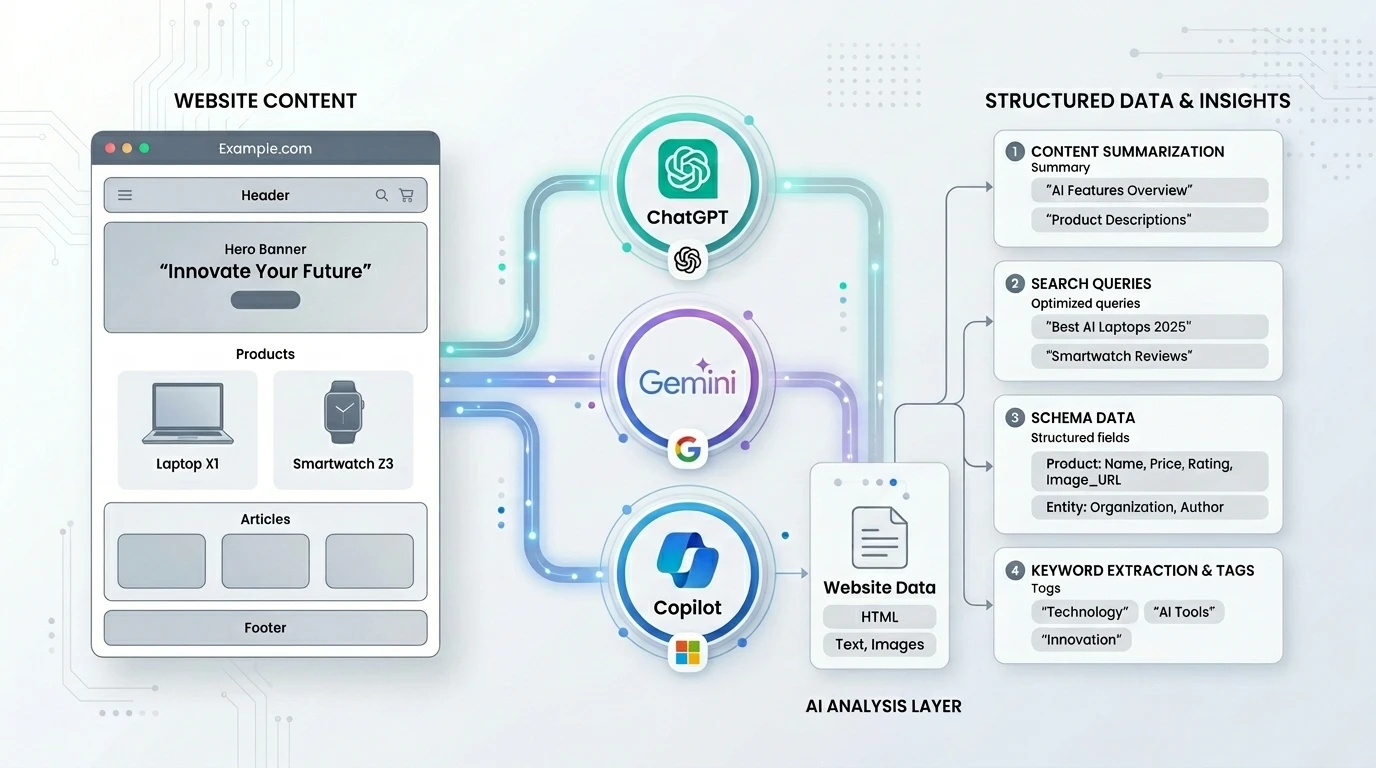
Your site is invisible to AI tools right now — and that’s not a traffic problem, it’s a citation problem. Here’s exactly how to fix it.
“Ranking” in AI Doesn’t Mean What You Think It Means
Forget everything you know about page one rankings.
ChatGPT doesn’t have a page one. Gemini doesn’t sort results by position. Copilot doesn’t reward the site with the most backlinks.
These tools do something different. They read a question, pull information from sources they trust, and write an answer. If your content is clear, credible, and structured well — they cite you inside that answer. If it’s not, they use someone else’s content and don’t mention you at all.
Getting “ranked” in AI means getting cited as a source inside generated answers — not appearing in a list of blue links.
A page gets mentioned inside a ChatGPT answer when it answers the question directly, uses simple and scannable language, comes from a domain that consistently covers the topic, and contains factual claims that can be verified. That’s the whole game. The rest of this article shows you how to win it.
How AI Search Actually Works
Google shows you a list of pages. You pick one. You read it.
AI tools work completely differently — and understanding the difference is the first step to getting cited.
When you type a question into ChatGPT, Gemini, or Copilot, here’s what happens behind the scenes. The tool retrieves information from its training data or, in the case of tools with live search, from indexed web pages. It evaluates which sources are most relevant, most trustworthy, and most clearly written. Then it generates a new answer — synthesizing everything it found into one coherent response, often citing sources at the end.
This process is called RAG — Retrieval-Augmented Generation.
The retrieval part decides whose content gets pulled. The generation part decides how it gets used. And the citation part decides whose name appears in the answer.
Here’s the key difference from Google SEO.
Google ranks pages
AI tools select content.
Google rewards authority and links
AI tools reward clarity and citability.
Google shows you options. AI gives you one answer — built from the sources it trusted most.
The question is no longer “can Google find my page?” — it’s “will AI trust my page enough to build its answer from it?”
Those are two very different standards. The second one is harder to meet — and almost no one is optimizing for it yet.
Core Factors That Determine Your AI Visibility
3.1 Content Relevance: Why Intent Beats Keywords Every Time
Keywords tell you what someone typed. Intent tells you what they actually need.
AI tools are built to understand intent, not match strings of text. A user asking “how do I get my website to show up in ChatGPT” and “how to appear in AI search results” are asking the exact same question in different words. AI recognizes this. Keyword-stuffed content does not serve either query well.
If someone searches “best running shoes for flat feet,” their intent is commercial — they want a recommendation, not a history of footwear. If someone asks “why do my feet hurt when I run,” their intent is informational — they want a diagnosis, not a product page.
Write content that satisfies the real need behind the query, not just the words in the query.
Here’s how to apply this. Take your target topic. Search it across Google, Perplexity, and ChatGPT. Look at what type of answer each returns. Is it a how-to guide? A comparison? A definition? That format tells you what satisfies intent for that topic. Match your content to that format exactly.
3.2 Topical Authority: Why One Article Will Never Be Enough
AI tools don’t cite one-hit wonders.
A site that has one article about SEO is not an authority on SEO. A site that has 40 deeply interconnected articles on SEO — covering keyword research, technical SEO, content strategy, link building, local SEO, and AI optimization — is a source that AI tools trust and return to repeatedly.
This is called topical authority, and it’s built through the pillar-cluster model.
Your pillar page covers a broad topic comprehensively. Your cluster pages each go deep on a specific subtopic within it. Every cluster links back to the pillar. The pillar links out to every cluster. Together, they signal to AI: this site owns this topic.
If your site covers digital marketing, your pillar might be “Complete Guide to Digital Marketing.” Your clusters: “How to Do Keyword Research,” “What Is Search Intent,” “How to Build Backlinks,” “How to Rank in AI Tools.” Each cluster strengthens the pillar. The pillar gives authority to each cluster.
A single excellent article gets ignored. Ten connected articles on the same topic get cited.
Start building clusters before you worry about anything else.
3.3 Entity-Based SEO: How AI Understands What Your Content Is Really About
AI doesn’t read your article word by word. It maps entities — real concepts, people, tools, brands, and relationships — and checks whether your content covers them correctly.
An entity is any clearly identifiable thing. “Google” is an entity. “Backlink” is an entity. “E-E-A-T” is an entity. “ChatGPT” is an entity. When AI reads a page about technical SEO, it expects to find related entities: crawlability, indexing, robots.txt, XML sitemap, Core Web Vitals, canonical tags, structured data.
If those entities are missing, the AI concludes your article is incomplete — even if the writing is excellent.
Here’s a practical entity map for a “technical SEO” article. Core entity: Technical SEO. Required connected entities: crawl budget, indexing, page speed, mobile-first indexing, schema markup, site architecture, Core Web Vitals, robots.txt, canonical URLs. Optional but strengthening entities: Google Search Console, Screaming Frog, log file analysis.
Use Google’s “People Also Ask,” related searches, and tools like InLinks or Surfer SEO to identify the entities your article must include to be seen as complete.
If you cover all the right entities in the right context, AI tools treat your page as a comprehensive source — and comprehensive sources get cited.
3.4 Content Clarity and Structure: The Format AI Prefers Above Everything Else
AI tools don’t like dense paragraphs. They like extractable answers.
When an AI model retrieves content to generate a response, it needs to pull a clean, self-contained answer quickly. A wall of text buries that answer. A well-structured page with clear headings, short paragraphs, and direct statements makes it easy to extract — and easy to cite.
Here’s the difference in real terms.
Bad structure: “SEO has changed significantly in recent years with the introduction of various algorithmic updates by Google which have placed emphasis on content quality and the user’s overall experience, including metrics that measure engagement, dwell time, and the speed at which content loads across devices including mobile phones.”
Good structure: “Google now ranks content based on three signals: content quality, user engagement, and page speed. Each one directly affects your position in search results.”
Same information. The second one is what AI picks up and uses.
Every section of your content should open with a direct, one or two sentence answer — then explain, then support with examples.
This format — answer first, context second — is exactly how AI wants to consume and redistribute information. It’s also what earns you the featured snippet, the voice search result, and the AI citation simultaneously.
3.5 Trust and Credibility: Why AI Ignores Content It Can’t Verify
AI tools are trained to avoid surfacing misinformation.
This means they actively favor content that demonstrates real expertise, shows real results, and can be verified. Generic advice from an anonymous author on a thin website gets filtered out. Specific, data-backed guidance from a named expert on an established domain gets cited.
This is the practical application of Google’s E-E-A-T framework — Experience, Expertise, Authoritativeness, Trustworthiness — and it applies equally to AI visibility.
Showing experience means including real screenshots, real case studies, and real numbers. “We increased organic traffic from 1,200 to 18,000 monthly visits in 9 months using this exact cluster strategy” is ten times more credible than “topical authority can significantly boost your traffic.”
Showing expertise means being specific in ways only practitioners are. Anyone can say “update your content regularly.” Someone with real expertise says “refresh articles every 90 days for fast-moving topics — update statistics, add new examples, revise the introduction, and update the date in your CMS.”
Add a detailed author bio with real credentials, a photo, and links to external work — AI tools use author signals as part of trust evaluation.
No author. No trust. No citation.
3.6 Source Citability: The Most Overlooked Factor in AI Visibility
This is the one most sites completely miss.
AI tools don’t just pick good content. They pick content that is easy to cite. That means the answer is clearly stated. The structure makes it scannable. The information is factually accurate and specific. And the page covers the exact question the user asked — not a vague version of it.
Think about how a journalist picks a source for an article. They want someone who gives a clear, quotable answer. They don’t want someone who rambles and hedges. AI tools work the same way.
Characteristics of highly citable content: opens with a direct definition or answer, uses numbered steps or clear subheadings, includes specific data and named examples, avoids vague language like “it depends” without following up with specifics, and covers the topic completely enough that no follow-up source is needed.
Here’s a real test for citability
Read your article and ask: if someone needed to quote one sentence from this article to answer the question, is there a sentence they could pull directly? If not, your content isn’t citable.
Rewrite your key conclusions as standalone, quotable sentences — one per section — that could be lifted and used inside an AI-generated answer as-is.
Do that for your top 10 articles this week.
3.7 Freshness: Why Outdated Content Gets Ignored by AI Tools
An article that explains “SEO best practices for 2023” is actively harmful in 2026.
AI tools with live search capabilities — like Gemini with Google integration and Copilot with Bing search — actively deprioritize outdated content. Why? Because citing outdated information damages the AI tool’s credibility with the user. These tools are trained to avoid that.
Even AI tools without live search — like older versions of ChatGPT — were trained on data with cutoffs. If your content existed and was cited during training, keeping it fresh increases the likelihood it was captured in an updated, accurate state.
Practically, this means: update any article that mentions specific years in the title. Refresh statistics every 6 months — especially in fast-moving fields like AI, digital marketing, finance, and health. Replace case studies with more recent ones when available. Add a “last updated” date stamp visibly on every article.
Content that was published three years ago and never updated is not a resource — it’s a liability.
Set a recurring calendar task: every Monday, refresh one older article. In six months, your entire content library will be current.
3.8 Technical Accessibility: The Floor Everything Else Sits On
AI tools that crawl the web — and increasingly, all of them do — need to be able to reach your pages.
If your site blocks crawlers in your robots.txt file, AI tools can’t read your content. If your pages take 8 seconds to load, some crawlers time out and move on. If your pages aren’t indexed, they don’t exist to any search-powered AI tool.
Three things to fix this week
First, open your robots.txt file and confirm you’re not accidentally blocking important content.
Second, check Google Search Console for any indexing errors and request re-indexing for pages marked as “Discovered — currently not indexed.”
Third, run your top 10 pages through PageSpeed Insights and get every page’s mobile score above 65.
A site that AI tools can’t crawl is invisible to AI tools — no amount of great content overcomes a technical block.
Fix the access problem before optimizing the content.
How to Optimize Your Content for AI Tools
Here is the exact workflow, step by step.
Step 1: Choose your query and map the intent
Pick a topic your audience searches for. Type it into Google, Perplexity, and ChatGPT. Notice whether the answers are how-to guides, definitions, comparisons, or step-by-step tutorials. Your content must match the dominant format.
Step 2: Build a topic cluster before writing
List 8 to 12 subtopics that relate to your main topic. Plan individual articles for each. This prevents you from writing isolated content that AI tools can’t place within a broader subject authority.
Step 3: Write AI-friendly content
Open every section with a direct answer. Keep paragraphs under 3 lines. Use subheadings every 200 to 300 words. Include specific numbers, named examples, and real results. Avoid vague statements. Cover every entity connected to the topic.
Step 4: Add internal links
Before publishing, link to 3 to 5 related articles on your site from within the body copy — not just at the bottom. After publishing, update 3 older articles to link to the new one. This builds the web of authority AI tools look for.
Step 5: Add structured data
Add Article schema to every post. Add FAQPage schema to any article with a FAQ section. Add HowTo schema for step-by-step guides. Use Google’s Rich Results Test to validate before publishing.
Step 6: Update content on a schedule
For AI, tech, and marketing content — every 90 days. For evergreen topics — every 6 months. Update statistics, refresh examples, revise introductions, and update the date stamp visibly on the page.
The Content Formats AI Tools Prefer to Cite
Not all content formats are equal in the eyes of AI.
Definition blocks perform exceptionally well
When a user asks “what is entity-based SEO,” AI tools look for a page that opens with a clear, concise definition — two to three sentences maximum. If your article buries the definition in paragraph four, you lose the citation to the site that put it in sentence one.
Step-by-step guides are AI’s favorite format for how-to queries
When someone asks “how to optimize for AI search,” a numbered guide with clear step titles is far more likely to be cited than a narrative article covering the same steps in paragraph form. The numbered format is extractable. Prose is not.
Comparison tables help AI answer “X vs Y” queries
A clearly formatted table comparing two tools, strategies, or approaches gives AI exactly what it needs to generate a fair, structured answer.
FAQ sections are citation gold
Every question in your FAQ section is a potential featured answer inside an AI response. Write each FAQ answer as if it’s the only sentence someone will read — complete, accurate, and standalone.
“How-to” content outperforms opinion content in AI citations by a significant margin, because it answers a specific, actionable query — exactly what AI is trying to satisfy.
Structure your content around these formats. Prose explanations support them. The formats lead.
Common Mistakes Killing Your AI Visibility
These are fixable. Most sites are making all of them.
Writing for keywords only means your article uses the phrase “AI SEO optimization” twelve times but never actually explains what AI does differently, what signals it evaluates, or how a site owner can respond. AI tools detect this immediately. Keyword density means nothing to a language model that’s evaluating semantic completeness.
No structure means one 2,000-word block of paragraphs with no headings, no numbered sections, no clear answer blocks. AI cannot efficiently extract a citable answer from that format. A competitor with a well-structured 1,200-word article on the same topic will be cited instead.
Shallow content means your article about “how to appear in ChatGPT” covers three points in 400 words without a single specific example, data point, or actionable step. AI tools favor completeness. Shallow content reads as incomplete to a language model — and incomplete content doesn’t get cited.
No internal linking means your article about AI SEO exists in isolation, with no connection to your articles on topical authority, structured data, or E-E-A-T. AI tools evaluate the broader domain context of a page. An isolated page looks like an isolated site — not an authority.
Ignoring entities means your article about Gemini search optimization doesn’t mention RAG, retrieval, generative AI, training data, source citability, or prompt engineering. The entity map is incomplete. The AI concludes your coverage is incomplete. You don’t get cited.
The fastest fix: take your five most important articles, check them against these five mistakes, and spend one hour per article fixing every one you find.
That’s five hours of work that could fundamentally change your AI visibility within 60 days.
Real Example: How to Structure One Topic for Full AI Visibility
Let’s use the niche of personal finance, specifically the topic of budgeting.
Your pillar page: “The Complete Guide to Budgeting: How to Manage Your Money in 2026.” This is a 3,500-word comprehensive resource covering what budgeting is, why it matters, the main methods, tools, and how to start. It’s the page you want cited whenever AI answers a broad budgeting question.
Your cluster pages: “How to Build a Zero-Based Budget From Scratch,” “50/30/20 Rule Explained With Real Examples,” “Best Free Budgeting Apps Compared,” “How to Budget on an Irregular Income,” “Why Most Budgets Fail in the First Month.”
Your internal linking map: Every cluster article links back to the pillar in the first 200 words. The pillar links out to every cluster in the relevant section. A new article — “How to Save Money While Paying Off Debt” — links to the pillar, to the zero-based budget article, and to the irregular income article.
Schema: The pillar has Article schema. The budgeting apps comparison has Product schema. The FAQ section on every page has FAQPage schema.
Every article in this cluster makes every other article stronger — and the pillar page becomes the most comprehensive budgeting resource AI has seen on your domain.
When a user asks ChatGPT “how do I start a budget,” the AI pulls from the site that has covered this topic from every angle. That’s now your site. That’s how you win the citation.
AI Search vs Google Search: What’s the Same, What’s Different
Some things carry over. Most do not.
What’s the same: technical accessibility still matters, domain authority and backlinks still contribute to trust signals, content quality and depth still determine whether sources get used, and E-E-A-T signals influence credibility in both systems.
What’s different:
Google ranks pages in a list. AI selects content to build one answer.
Google rewards keyword optimization. AI rewards intent satisfaction and entity coverage.
Google shows you multiple perspectives. AI synthesizes them into one — often citing only one or two sources.
Google’s ranking signals are relatively public. AI citation logic is still largely opaque and evolving.
The most important difference: in Google SEO, you’re competing for a position on a page with nine other results. In AI search, you’re competing to be the one source that gets cited inside a generated answer.
In AI search, second place means you don’t exist — there’s no page two, no position four, no alternative blue link. You’re either cited or you’re not.
This raises the stakes dramatically. It also makes the opportunity clearer: build the most trustworthy, complete, and clearly structured content in your niche, and you become the default source AI tools reach for.
The Future of AI SEO
The shift has already happened. Most people just haven’t noticed yet.
The future of search is not ten blue links. It’s one generated answer with two or three cited sources. Every major search engine is moving in this direction. The question is not whether AI-generated answers will dominate — they already do for a growing percentage of queries. The question is whether your site will be cited in those answers or invisible to them.
Visibility will replace ranking as the primary metric. Instead of “what position am I on Google,” the question will be “am I being cited by AI tools when my topic comes up?” Tools to measure this are already emerging — platforms like Semrush and Ahrefs are beginning to track AI mention share.
Brand authority will become more valuable than it has ever been. AI tools are trained to trust recognized, frequently cited sources. The more your site is cited, linked to, and mentioned across the web, the more AI tools treat you as a default authority. Building your brand — through original research, media mentions, and consistent publishing — is no longer just a PR strategy. It’s an SEO strategy.
The sites that build topical authority and brand recognition today will own AI visibility for the next decade — and the window to get there first is still open.
FAQs
How do you rank in ChatGPT?
ChatGPT doesn’t rank pages the traditional way. It selects sources based on how clearly and completely they answer a question. To appear in ChatGPT answers, your content must match the user’s search intent exactly, cover all related entities for the topic, use a clear and scannable structure, come from an established domain with topical authority, and be accessible to web crawlers if using a browsing-enabled version.
Does AI use Google rankings to decide what to cite?
Partially, but not directly. AI tools like Gemini use Google’s index as part of their retrieval layer, which means pages that rank well on Google are more likely to be retrieved. However, a page that ranks position 6 on Google but is more clearly written and more completely structured may be cited over the page in position 1. Citability and clarity matter independently of Google position.
How do you get cited by AI tools?
Get cited by writing content that opens with a direct, extractable answer. Use clear subheadings, numbered steps for how-to content, and FAQ sections with standalone answers. Cover every entity connected to your topic. Build topical authority through a cluster of interconnected articles. Maintain technical accessibility for crawlers. Update content every 90 days for fast-moving topics.
How long does it take to appear in AI citations?
There’s no fixed timeline. Sites with existing domain authority that optimize for clarity and entity coverage often see improved AI citation within 60 to 90 days. Newer sites building topical authority from scratch should expect 6 to 12 months before consistent AI visibility. The compounding effect of a cluster strategy means visibility accelerates over time.
Start Here, Not Everywhere
Four things separate the sites AI tools cite from the ones they ignore.
Match intent before writing a word — the format and depth of your content must mirror what the query actually demands.
Build topical authority through clusters, not isolated articles — one great page is invisible without the supporting network.
Structure content for extraction — direct answers, clear headings, standalone FAQ responses, and quotable conclusions.
Update everything on a schedule — outdated content is a trust signal in the wrong direction.
The window to build AI visibility before the competition catches on is real and it’s closing. The sites that establish authority, clarity, and trust in the next 12 months will be the ones AI defaults to for the next decade.
Your next article isn’t just a blog post. It’s a citation waiting to happen — if you write it the right way.

Senior SEO Analyst with 5+ years experience. I specialize in Local SEO, Technical SEO, and AI search visibility through AEO and GEO strategies. Everything I write is tested against real search performance, not borrowed from someone else’s playbook.