11 Best SEO Tools in 2026 – Free & Paid
Why You Need an SEO Tool in 2026
Let’s be honest — trying to grow your website’s visibility on Google without an SEO tool is like trying to navigate a new city without Google Maps. You might get there eventually, but it’ll take forever and you’ll probably make a lot of wrong turns.
SEO tools do the heavy lifting for you. They tell you which keywords people are searching for, how your competitors are winning, what’s broken on your website, and whether your content is good enough to rank. The best ones even tell you how your brand shows up in AI tools like ChatGPT.
With over 450 SEO tools now available — many adding AI features in 2025 and 2026 — it can feel overwhelming. We’ve done the research on online blogs and made this content.
Here’s a simple breakdown of everything you need to know.
What Is an SEO Tool, Exactly?
An SEO tool is software that helps you improve how your website ranks in search engines like Google. Depending on the tool, it might help you:
- Find the right keywords to target
- See how your competitors are getting their traffic
- Fix technical problems on your site that hurt your rankings
- Write better content that Google actually wants to show users
- Track how you’re ranking over time
- Build links from other websites (which tells Google you’re trustworthy)
Most tools fall into one of four types:
- All-in-one platforms: Do everything from keyword research to audits to backlink analysis. Great if you want one tool that covers all bases.
- Rank trackers: Primarily track where you rank on Google for specific keywords. Usually include some extra features too.
- SEO audit tools: Scan your website for problems and tell you what to fix.
- Keyword research tools: Help you find and analyze the search terms your audience is using.
What’s New in SEO Tools for 2026?
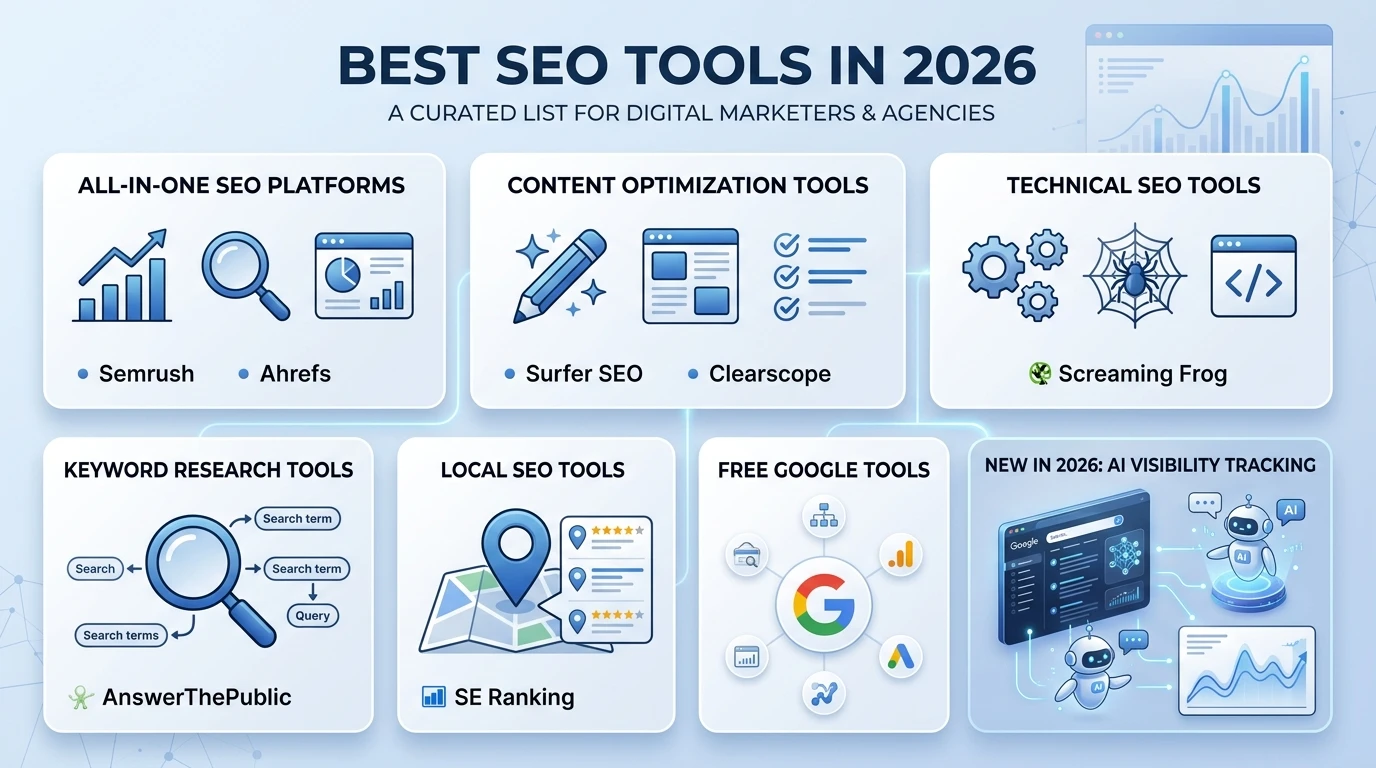
The biggest shift in 2026 is the rise of AI search visibility — sometimes called GEO (Generative Engine Optimization). With tools like ChatGPT, Perplexity, and Google’s AI Overviews sending answers directly to users, many people never even click through to a website anymore.
The top SEO tools are now tracking not just Google rankings, but also how often your brand gets mentioned in AI-generated answers. This is a brand new frontier, and the tools below are starting to tackle it head-on.
The Best SEO Tools of 2026
1. Semrush — Best All-in-One SEO Platform
Category: All-in-One / Rank Tracker | Price: From $139.95/month
Semrush is probably the most well-known name in SEO software, and for good reason. It’s been at the top of the game for over a decade, and in 2026, it’s stepped up even further by adding AI visibility tracking alongside its classic SEO features.
Think of Semrush as your SEO command centre. You can type in a competitor’s website and instantly see how much traffic they’re getting, which keywords are driving that traffic, and whether they rely on branded searches. You can then use that intelligence to plan your own strategy.
What’s new in 2026: Semrush now monitors how your brand appears inside ChatGPT, Perplexity, Gemini, and Google AI Overviews — so you can see if AI tools are recommending you to users before they even search.
Standout features include:
- Domain Overview for competitor traffic analysis
- Keyword Gap tool to find keywords your rivals rank for that you don’t
- Backlink Gap to identify link-building opportunities
- Position Tracking for daily keyword ranking updates
- AI Visibility Toolkit to track brand mentions across major AI platforms
Best for: Businesses and marketers who need a comprehensive tool for SEO, content, and AI visibility all in one place.
Watch out for: It can feel overwhelming at first, and full AI visibility features cost extra.
2. Ahrefs — Best for Competitor Research & Backlinks
Category: All-in-One / Rank Tracker | Price: From $129/month
Ahrefs is Semrush’s closest rival, and many SEO professionals actually prefer it for backlink analysis and competitor research. Its data quality is consistently praised as among the best in the industry.
The standout feature is the Content Gap tool, which shows you exactly which keywords your competitors are ranking for that you’re not. This is gold for content planning. You can also use the Link Intersect tool to find websites that link to your competitors but not to you — and then reach out to get those links for yourself.
In 2026, Ahrefs also added Brand Radar as a paid add-on, which tracks how your brand shows up in AI platforms. It’s one of the more mature AI visibility tools, though it comes at a significant cost.
Best for: SEO professionals and agencies who want the best-in-class data for backlink analysis and competitor intelligence.
Watch out for: It’s a database for experts. If you’re new to SEO, the interface can feel like being handed a plane’s cockpit without any training.
3. Surfer SEO — Best for AI-Powered Content Writing
Category: SEO Audit / Content Optimization | Price: From $99/month
Surfer SEO is built around one core idea: compare your content to what’s already ranking well on Google, then show you exactly what you’re missing. It does this better than almost anyone else.
When you start writing an article in Surfer’s Content Editor, it immediately shows you a real-time score based on how your content stacks up against the top-ranking pages for your target keyword. It suggests related terms to include, shows ideal word counts, and even lets you generate entire AI-written drafts.
The SERP Analyzer is also excellent — it gives you a visual, interactive breakdown of what the top 48 ranking pages do differently from yours, including word counts, keyword density, and backlink profiles.
Surfer now includes AI article generation on all plans, and integrates with Jasper for even more powerful AI-assisted writing.
Best for: Content creators, bloggers, and marketers who publish articles regularly and want to optimize every piece for search.
Watch out for: Credits don’t roll over month-to-month, and the AI article feature is capped per plan.
4. Screaming Frog SEO Spider — Best for Technical SEO
Category: Technical SEO Audit | Price: Free (up to 500 URLs) / $259 per year
If SEO were a car, Screaming Frog would be the mechanic who checks under the hood. It crawls your entire website the same way Google does, and shows you every technical issue that could be holding your rankings back.
Broken links, missing meta descriptions, duplicate content, slow-loading pages, redirect chains — Screaming Frog finds all of it, and fast. You can connect it to Google Analytics and Google Search Console to see the full picture in one place.
In 2026, it also integrates with OpenAI, so you can automatically generate optimised meta descriptions and alt text for images using AI — a huge time-saver for large websites.
Best for: SEO professionals, developers, and agencies doing deep technical audits of websites.
Watch out for: It’s a desktop app (you download it to your computer), which can be limiting if you’re used to cloud-based tools. There’s also a steep learning curve for beginners.
5. Clearscope — Best for Content Optimization
Category: Content SEO / AI-Assisted Optimization | Price: From $189/month
Clearscope is laser-focused on one thing: making your content good enough to rank. You give it a target keyword, and it shows you every related term, topic, and question that the top-ranking pages cover — so you can make sure your article is comprehensive.
What makes Clearscope special is its ability to flag content decay — pages on your site that are losing traffic. It alerts you when a page has dropped significantly, telling you it’s time for a refresh before competitors take your spot.
The Content Editor integrates directly with Google Docs and WordPress, so you don’t have to copy-paste between platforms.
New in 2026: Clearscope highlights ‘Trending’ keywords — terms whose search volume is growing by more than 50% over two months. This lets you get in early on rising topics before they become competitive.
Best for: Content teams that publish frequently and need to ensure every article is fully optimized and stays relevant over time.
Watch out for: Clearscope does one thing really well, but it’s expensive for a single-purpose tool. The monthly credit system can also feel limiting.
6. Mangools — Best for Beginners
Category: All-in-One (Beginner-Friendly) | Price: From $49/month
SEO tools can be intimidating. Mangools is the exception. It packs five clean, intuitive tools into one dashboard without overwhelming you with data. If you’re just starting out, this is where to begin.
The five tools included are:
- KWFinder: Find keywords with search volume, difficulty, and long-tail suggestions — without the data overload.
- SERPChecker: See how hard it would be to rank for a keyword by checking competitors’ domain authority and backlinks.
- SERPWatcher: Track how your rankings change over time and get alerts for big moves.
- LinkMiner: Analyse competitors’ backlinks to find linking opportunities for your own site.
- SiteProfiler: Get a full overview of any website’s SEO health and authority metrics.
Best for: Small business owners, bloggers, and SEO beginners who want a simple, affordable tool that actually gets results.
Watch out for: Daily usage limits on lower plans can be frustrating if you’re managing several websites.
7. SE Ranking — Best for Local SEO
Category: All-in-One / Local SEO | Price: From $65/month
If your business depends on showing up in local searches — ‘best pizza near me’ or ‘plumber in Birmingham’ — SE Ranking is built exactly for that. It’s an all-in-one tool with a particularly strong set of local SEO features.
You can set up location-specific rank tracking on a map, monitoring how you rank in different areas — perfect for businesses with multiple service locations. It also connects directly to your Google Business Profile, so any updates you make in SE Ranking automatically sync to Google.
The Reviews Management feature pulls in your online reviews from Google, Facebook, Yelp, and more — and lets you reply to them all from one dashboard.
Best for: Local businesses, restaurants, service providers, and anyone who needs to rank in location-based searches.
Watch out for: Some advanced features now require paid add-ons, which can make the actual price higher than it first appears.
8. AnswerThePublic — Best for Budget Keyword Research
Category: Keyword Research | Price: Free tier available / From $11/month
AnswerThePublic (ATP) takes a refreshingly human approach to keyword research. Instead of just giving you a list of search terms, it shows you the questions, prepositions, and comparisons that real people type into Google related to your topic.
When you enter a topic, you get a visual wheel of questions like ‘how,’ ‘are,’ ‘will,’ ‘can for,’ ‘without’ — giving you an instant window into what your audience actually wants to know. This makes it incredibly useful for blog ideas, FAQ pages, and content strategy.
At $11/month (or a one-time $119 lifetime fee for the Individual plan), it’s also one of the most affordable SEO tools available.
Best for: Bloggers, content marketers, and small businesses who want to understand their audience and generate content ideas without spending a lot.
Watch out for: The free version has become more restricted recently. Also, ATP gives you ideas but not deep data — pair it with a keyword research tool for search volume and difficulty metrics.
9. BuzzSumo — Best for Content Ideation
Category: Keyword Research / Content Discovery | Price: From $199/month
BuzzSumo is less about rankings and more about ideas. It helps you discover what content is already performing well in your industry — which topics get the most shares, which formats work best, and what questions your audience is asking online.
The Content Generator is a standout feature: type in a topic and it gives you evergreen content ideas, engagement score projections, and even suggested publishing times and social media platforms. It essentially tells you what to write before you write it.
Best for: Content strategists, PR teams, and marketers who want data-driven inspiration for what to create next.
Watch out for: It’s pricey for a content research tool, and it doesn’t replace a full SEO platform for ranking and backlink data.
10. Google’s Free SEO Tools — Always Worth Using
Category: Various | Price: Free
No matter how many paid tools you use, Google’s own free tools are non-negotiable. They offer data accuracy that no third-party tool can match, because it comes straight from the source.
- Google Search Console: Tracks your website’s performance in Google search — clicks, impressions, keyword positions, and technical issues.
- Google Analytics: Shows you how visitors find and use your website.
- Google Keyword Planner: Great for discovering keyword ideas and search volumes (originally built for ads, useful for SEO too).
- Google PageSpeed Insights: Tests how fast your website loads and gives you actionable tips to speed it up.
- Google Trends: Lets you explore how search interest in any topic has changed over time.
- Google Rich Results Test: Checks whether your structured data is set up correctly so you can appear in rich snippets on Google.
Google Search Console and Google Analytics should be set up on every website, regardless of which other tools you use. They’re free, and they give you the most accurate data available.
11. WordPress Plugins — Yoast SEO & Rank Math
Category: On-Page Optimization (WordPress) | Price: Free tiers available
If your website runs on WordPress, you’ll want one of these two plugins. They make on-page SEO practically automatic — checking your content as you write and flagging issues like missing keywords, short meta descriptions, or poor readability.
Yoast SEO: The original and most widely used WordPress SEO plugin. It’s beginner-friendly, generates XML sitemaps automatically, and gives you a real-time preview of how your page will look in Google search results.
Rank Math: A newer competitor to Yoast that offers more features on its free plan, including redirect management and schema markup. Slightly more technical but very powerful.
Both tools also handle important technical SEO elements like canonical URLs and structured data, which help Google understand your content better.
Best for: Anyone running a WordPress website who wants to optimize content without needing deep technical knowledge.
Quick Comparison: Which Tool Is Right for You?
| Tool | Best For | Starting Price | Skill Level |
| Semrush | All-in-one + AI visibility | $139.95/mo | Intermediate |
| Ahrefs | Backlinks & competitor research | $129/mo | Intermediate–Expert |
| Surfer SEO | AI content writing & optimization | $99/mo | Beginner–Intermediate |
| Screaming Frog | Technical SEO audits | $279/year | Expert |
| Clearscope | Content optimization | $129/mo | Intermediate |
| Mangools | Beginners & budget users | $39.65/mo | Beginner |
| SE Ranking | Local SEO | $129/mo | Beginner–Intermediate |
| AnswerThePublic | Budget keyword research | $10/mo | Beginner |
| BuzzSumo | Content ideation | $199/mo | Intermediate |
| Google Tools | Baseline data & free audits | Free | Beginner |
| Rank Math Plugin | WordPress on-page SEO | Free / from 44.99/mo | Beginner |
| Yoast Plugin | WordPress on-page SEO | Free / from $118.80/mo | Beginner |
How to Choose the Right SEO Tool
The ‘best’ tool is the one that fits your specific situation. Here’s a simple way to think about it:
- You’re completely new to SEO: Start with Google Search Console (free) + Mangools or Yoast. Learn the basics before investing in more powerful tools.
- You’re a blogger or content creator: Surfer SEO or Clearscope will help you write content that actually ranks, and AnswerThePublic is great for idea generation.
- You run a local business: SE Ranking’s local features are exactly what you need to dominate local search results.
- You want to understand your competitors: Ahrefs or Semrush will give you the most detailed competitor intelligence available.
- You have a WordPress website: Install Yoast or Rank Math immediately — they’re free and make on-page SEO nearly automatic.
- You need enterprise-level SEO: Semrush, Ahrefs, or seoClarity offer the depth and scale that large organisations need.
- You’re on a tight budget: Google’s free tools are a great foundation, and Mangools or Screaming Frog (free version) give you solid extra capability without breaking the bank.
The 2026 Trend You Shouldn’t Ignore: AI Visibility
Traditional SEO focuses on ranking on Google. But in 2026, a growing share of people get their answers directly from AI tools — and never visit any website at all.
When someone asks ChatGPT ‘What’s the best project management software?’, it gives an answer. If your brand gets mentioned in that answer, you win visibility without a single click needed on Google. If it doesn’t — you’re invisible to those users.
This is why tools like Semrush, Ahrefs Brand Radar, and SE Ranking now offer AI tracking features. It’s early days, but optimising for AI mentions (sometimes called GEO — Generative Engine Optimization) is becoming the next frontier in digital marketing.
Tip: To increase your chances of being cited by AI tools, focus on becoming a trusted, authoritative source in your niche. Publish high-quality, well-structured content, earn backlinks from credible sites, and make sure your brand has a strong, consistent online presence.
You don’t need every tool on this list. Most people will do just fine with one solid all-in-one platform (like Semrush or Mangools depending on budget), the free Google tools, and a WordPress plugin if applicable.
The most important thing is to actually use the tools consistently. An expensive SEO suite gathering dust won’t help you. A simple tool you check every week absolutely will.
Start small, learn what the data is telling you, and add more tools as your needs grow. The best SEO strategy in 2026 is the one you actually follow through on.

Senior SEO Analyst with 5+ years experience. I specialize in Local SEO, Technical SEO, and AI search visibility through AEO and GEO strategies. Everything I write is tested against real search performance, not borrowed from someone else’s playbook.