Topical Authority in 2026: The Complete Guide to Building Authority That Actually Ranks
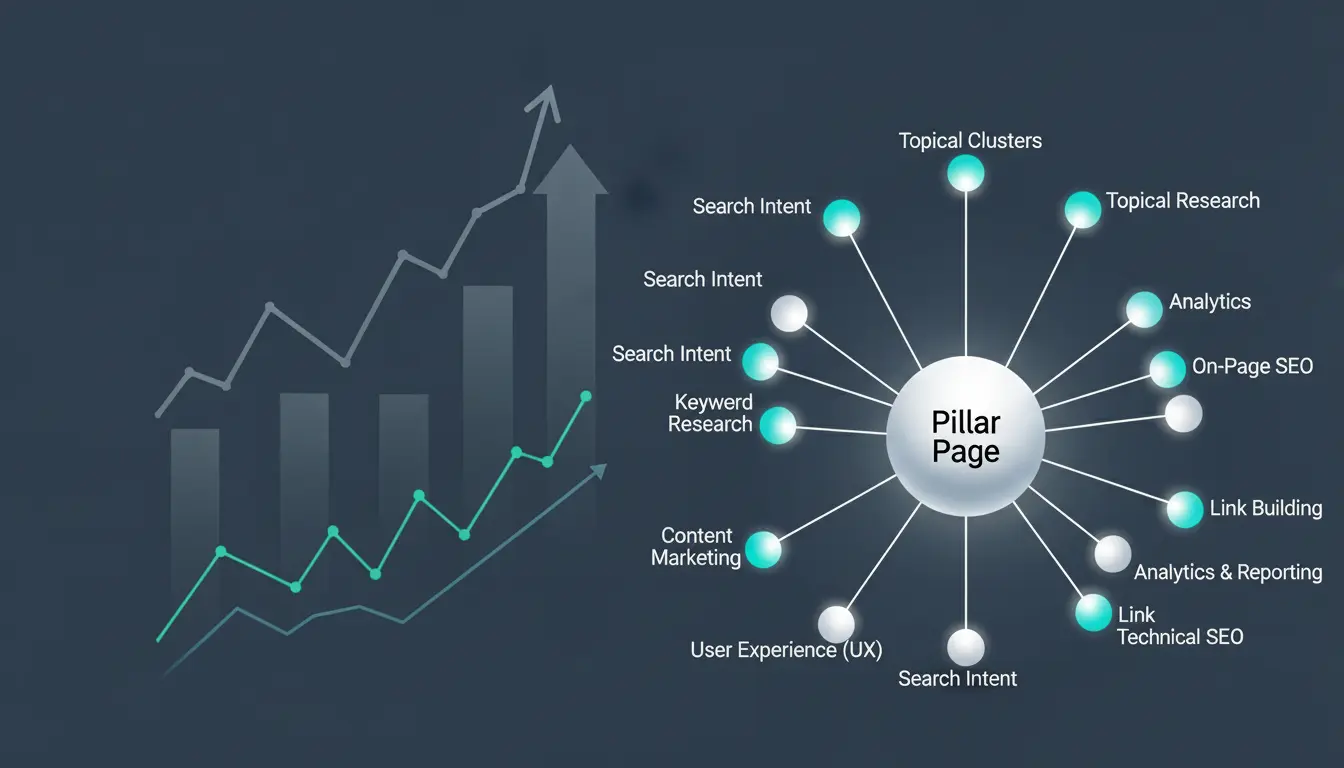
If you want your website to rank consistently in 2026, stop trying to rank individual keywords and start building topical authority.
Search engines no longer evaluate pages in isolation. Instead, they evaluate whether your website fully understands and covers an entire subject. When Google sees consistent expertise across a topic, it begins to trust your content. That trust leads to faster indexing, stronger rankings, and visibility across hundreds of related searches.
In simple terms: websites that own a topic win search traffic.
This guide explains exactly how to build topical authority in 2026 using modern SEO principles, AI-aware content structure, and entity-based optimization.
What Topical Authority Actually Means
Topical authority refers to how strongly search engines associate your website with expertise in a specific subject area. Instead of ranking a single page for a keyword, Google evaluates whether your site demonstrates deep knowledge across the entire topic ecosystem.
For example, imagine two websites writing about SEO.
Website A publishes one article about “keyword research.”
Website B publishes:
- a keyword research guide
- keyword research tools comparison
- long-tail keyword strategies
- search intent analysis
- competitor keyword research
- keyword clustering tutorials
Google sees Website B as the authority because it covers the topic comprehensively.
That depth creates context. And context creates rankings.
This is why modern SEO strategies prioritize topic coverage over keyword density.
Why Topical Authority Matters More in 2026
Search engines have evolved significantly in the past few years. AI-driven search, semantic understanding, and conversational queries have changed how rankings work.
Here are the major reasons topical authority now dominates SEO.
1. Search Engines Understand Context
Search engines now interpret meaning rather than just keywords. Instead of asking “does this page contain the keyword,” algorithms ask whether the site is a trusted source for the entire subject.
That means scattered articles rarely perform well anymore.
Structured expertise wins.
2. AI Search and Overviews Prefer Authoritative Sources
AI search engines assemble answers from trusted sources. Sites with strong topical authority are more likely to be referenced in AI summaries and answer engines.
The stronger your topic coverage, the more likely AI systems will cite your content.
3. New Content Ranks Faster
Once Google trusts your site for a topic, new articles in that niche rank significantly faster.
Some studies show that authoritative sites can rank multiple times faster for new content compared to sites without topic authority.
This is why large authority sites seem to dominate search results.
They aren’t publishing better articles.
They already own the topic.
4. Rankings Become More Stable
Keyword-focused sites often lose rankings after algorithm updates.
But topic-focused sites survive longer because they provide complete coverage rather than isolated pages.
The deeper your coverage, the harder it becomes for competitors to outrank you.
How Topical Authority Actually Works
Topical authority is built through three major signals:
- Content depth
- Content structure
- Content relationships
Search engines analyze how your content connects together.
A well-structured topic cluster sends clear signals that your site understands the subject.
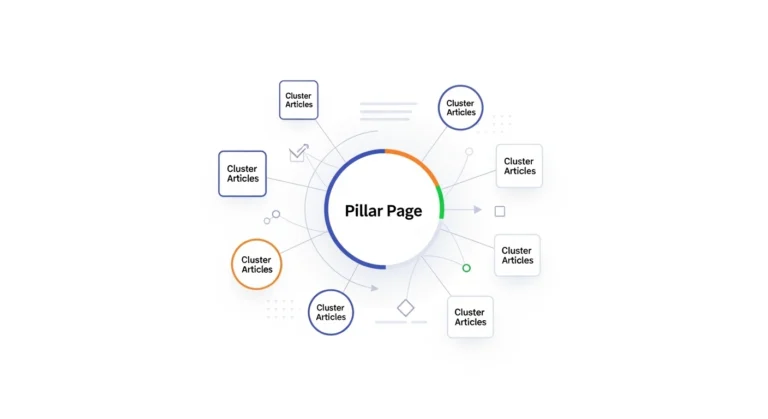
Here is the typical architecture.
Pillar Pages
A pillar page is the main guide for a topic.
It usually contains:
- a full overview of the subject
- definitions and fundamentals
- internal links to detailed articles
Think of the pillar page as the central hub of your topic.
Cluster Articles
Cluster pages explore specific subtopics in detail.
For example, a pillar article about “SEO Keyword Research” might link to:
- keyword research tools
- search intent analysis
- competitor keyword research
- long-tail keyword strategies
- keyword clustering
Each article solves one specific question.
Internal Linking
Internal links connect all cluster articles back to the pillar page.
This creates a web of topical relationships that search engines can easily understand.
This architecture is known as the hub-and-spoke model, and it is one of the most effective ways to demonstrate topical authority.
Step 1: Choose a Topic You Can Actually Own
Many websites fail before they even begin.
They choose topics that are either:
- too broad
- too competitive
- unrelated to their expertise
Instead, choose a topic where you can realistically publish 20–100 pieces of content over time.
A good topic should:
- align with your business
- have clear subtopics
- contain ongoing search demand
For example:
Bad topic choice:
Digital Marketing
Better topic choice:
Technical SEO
Even better:
Technical SEO for SaaS websites
The narrower the niche, the easier it is to establish authority.
Step 2: Build a Complete Topical Map
Once the topic is defined, the next step is building a topical map.
A topical map is a structured list of all related subtopics within your niche.
Start with a seed topic and expand it using:
- Google autocomplete
- People Also Ask questions
- competitor content analysis
- keyword tools
- community forums
Many successful SEO strategies begin by mapping 50–100 potential subtopics before writing any content.
This prevents random publishing.
Instead of guessing what to write next, you follow a structured roadmap.
Step 3: Create a Pillar Page
Your pillar page should act as the main entry point for the topic.
A strong pillar page includes:
- a clear explanation of the topic
- structured sections covering core ideas
- links to detailed cluster articles
- helpful visuals or frameworks
- a table of contents for navigation
Importantly, pillar pages are not just long articles.
They are navigation hubs that guide readers through the topic.
This improves both user experience and crawlability.
Step 4: Build Cluster Articles
Cluster articles are where topical authority really grows.
Each cluster article should target one specific question or intent.
Examples include:
- how-to guides
- comparisons
- tutorials
- definitions
- use cases
- case studies
- seo tools lists
The key rule is simple:
One page = one intent.
When pages overlap, they compete with each other instead of strengthening the cluster.
Avoid duplicate intent at all costs.
Step 5: Use Strategic Internal Linking
Internal linking is the backbone of topical authority.
Without strong internal linking, search engines struggle to understand relationships between your pages.
A strong linking strategy includes:
- pillar page linking to cluster pages
- cluster pages linking back to the pillar
- related cluster articles linking to each other
These links create contextual relevance.
Search engines can clearly see that every page belongs to the same topic ecosystem.
Step 6: Focus on Entities, Not Just Keywords
Entity-based SEO is becoming a core part of topical authority.
An entity is a specific concept or object that search engines understand.
Examples of entities include:
- brands
- products
- technologies
- frameworks
- people
- locations
Modern SEO strategies connect content using entities instead of repeating keywords.
For example, an article about SEO might reference entities like:
- search intent
- structured data
- crawling
- indexing
- ranking signals
These relationships help search engines understand the broader context of your topic.
Step 7: Demonstrate Real Expertise
Publishing dozens of articles is not enough.
Search engines now evaluate experience and credibility as part of content quality.
Ways to demonstrate expertise include:
- author bios
- case studies
- personal insights
- original data
- screenshots
- tutorials
- real examples
These signals strengthen trust.
Generic AI-generated content without expertise rarely builds authority today.
Step 8: Maintain Publishing Consistency
Consistency is a major factor in building topical authority.
A site publishing one article every few months will struggle to build topic depth.
Instead, aim for a structured publishing cadence such as:
- 2–4 articles per month
- quarterly content updates
- continuous internal linking improvements
Consistent expansion of a topic cluster signals ongoing expertise.
Step 9: Refresh and Consolidate Old Content
Topical authority is not only about creating new content.
It also requires maintaining existing content.
Over time, websites accumulate:
- outdated articles
- overlapping topics
- thin content
These issues weaken topical signals.
A quarterly content audit should:
- merge overlapping posts
- update outdated information
- improve internal links
- expand thin pages
This process strengthens the overall topic cluster.
Step 10: Earn External Mentions and Links
Even though topical authority focuses heavily on content structure, external signals still matter.
Search engines consider:
- backlinks
- brand mentions
- citations
- engagement signals
External references validate your expertise.
When other websites cite your content, search engines gain additional trust in your authority.
Common Topical Authority Mistakes
Many websites attempt topical authority but fail due to structural issues.
Here are the most common mistakes.
Publishing Random Articles
Random publishing prevents search engines from identifying your expertise.
Your content should always connect to a defined topic cluster.
Keyword Stuffing Instead of Topic Coverage
Repeating keywords does not build authority.
Comprehensive topic coverage does.
Weak Internal Linking
If your articles are not connected properly, search engines cannot understand topic relationships.
Internal links are essential.
Ignoring Content Updates
Topics evolve quickly.
Outdated content weakens authority signals.
Covering Too Many Topics
Trying to cover multiple niches slows down authority growth.
Focus on owning one topic first.
How AI Is Changing Topical Authority
AI tools are making it easier than ever to generate content.
But that also means competition is increasing rapidly.
Many marketers now use AI to:
- generate topical maps
- create content outlines
- identify content gaps
- plan internal linking structures
Some SEO professionals report building entire topic clusters much faster using AI-assisted workflows.
However, AI alone cannot create authority.
Real expertise, unique insights, and structured content are still required to stand out.
In fact, the rise of AI has increased the importance of original value.
Surface-level content is everywhere now.
Only deeply useful content earns authority.
The Future of Topical Authority
Looking ahead, topical authority will become even more important because search is shifting toward:
- AI-generated answers
- conversational search
- entity-based indexing
- knowledge graph relationships
Search engines are moving away from keyword-based ranking toward knowledge-based ranking.
In this environment, the sites that win will be those that build complete knowledge hubs around specific topics.
This approach aligns perfectly with how modern search systems understand information.
Final Thoughts
Topical authority is no longer an optional SEO strategy.
It is the foundation of modern search visibility.
Instead of chasing individual keywords, focus on owning a topic.
Build pillar pages that define the subject.
Create cluster articles that answer specific questions.
Connect everything through strong internal linking.
Demonstrate expertise with real insights and experience.
When your website consistently publishes structured, high-quality content around a topic, search engines begin to trust your site.
And once that trust is established, rankings become predictable, scalable, and far easier to maintain.
Topical authority is not a quick SEO trick.
But it is the closest thing to a long-term search engine advantage in 2026.

Senior SEO Analyst with 5+ years experience. I specialize in Local SEO, Technical SEO, and AI search visibility through AEO and GEO strategies. Everything I write is tested against real search performance, not borrowed from someone else’s playbook.