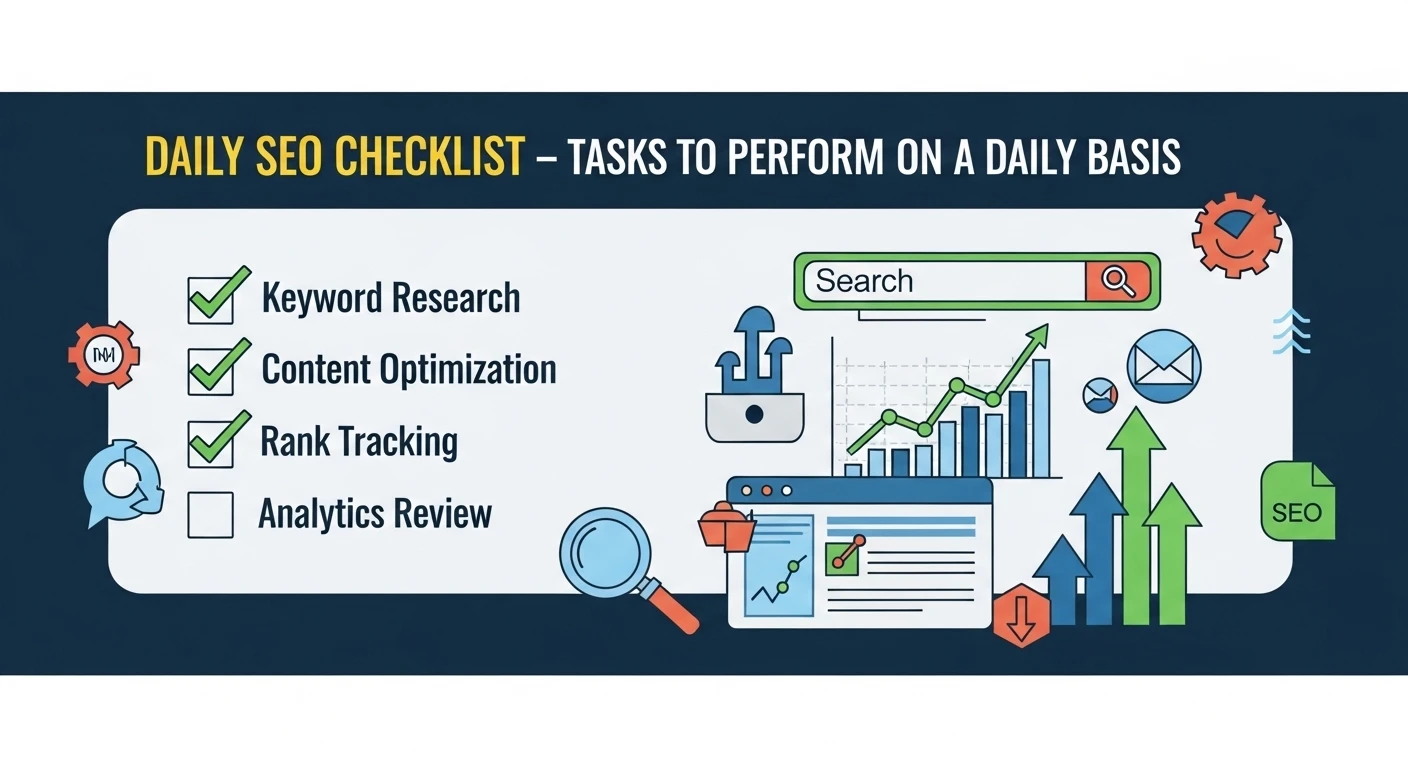
Daily SEO Checklist – Tasks to Perform on a Daily Basis
SEO in 2026 isn’t about random tactics. It’s about consistent execution.
You don’t rank because you “did SEO.”
You rank because you do the right SEO tasks every single day.
Algorithms are smarter. AI-generated content is everywhere. Competition is tighter. And attention spans? Lower than ever.
If you want steady growth, you need a repeatable daily system.
This is your complete daily SEO checklist for 2026 — built for bloggers, niche site owners, affiliate marketers, SaaS brands, and service businesses.
Let’s get into it.
Why a Daily SEO Checklist Matters in 2026
Search engines are evolving fast. Updates powered by AI systems like Google’s Google ranking models (including advancements based on Google BERT and Google MUM) now evaluate:
- Content depth
- Topical authority
- User experience
- Real engagement signals
That means you can’t “set and forget” SEO anymore.
You monitor.
You improve.
You optimize daily.
The good news? Most of your competitors don’t.
That’s your edge.
The Ultimate Daily SEO Checklist (2026 Edition)
Follow these steps daily. Total time required: 45–90 minutes.
1. Check Google Search Console (10 Minutes)
Your first stop every day: Google Search Console.
Why? Because this is where real SEO data lives.
What to Check:
A. Performance Report
- New keyword impressions
- Click-through rate (CTR) drops
- Pages losing clicks
- Pages gaining traction
Look for:
- Keywords ranking in positions 8–20 (quick win opportunities)
- Pages with high impressions but low CTR
These are optimization goldmines.
B. Indexing Issues
- New “Crawled – currently not indexed” pages
- Coverage errors
- Manual actions (rare, but check)
If something breaks, you want to catch it early.
Daily monitoring = zero surprises.
2. Monitor Rankings (5–10 Minutes)
Use your rank tracking tool to check:
- Core money keywords
- Blog pillar pages
- Newly published articles
You’re not obsessing.
You’re looking for trends.
If a page drops:
- Did competitors update content?
- Did you lose backlinks?
- Was there a recent algorithm shift?
Quick response beats panic.
3. Check Organic Traffic in Analytics (5 Minutes)
Open Google Analytics.
Look at:
- Daily organic sessions
- Traffic by landing page
- Bounce rate spikes
- Engagement time drops
If a high-traffic page suddenly dips, investigate immediately.
Small daily checks prevent major traffic crashes.
4. Optimize 1 Existing Page (20 Minutes)
This is where real growth happens.
Instead of publishing endlessly, improve what already ranks.
Daily task: optimize ONE page.
How?
Step 1: Add Topical Depth
- Expand thin sections
- Add FAQs
- Cover related subtopics
Step 2: Improve On-Page SEO
- Add internal links
- Improve headings (H2/H3 clarity)
- Add missing semantic keywords
Step 3: Increase CTR
- Rewrite meta title
- Improve meta description
- Add numbers, benefits, curiosity
Often, small tweaks = ranking jumps.
Do this daily for 30 days.
You’ll see momentum.
5. Build Internal Links (10 Minutes)
Internal linking is still underrated in 2026.
Search engines use internal links to understand:
- Topic clusters
- Content hierarchy
- Page importance
Daily habit:
- Add 3–5 internal links from older articles to newer ones
- Use descriptive anchor text
- Link to underperforming pages
This alone can move rankings.
6. Monitor Competitors (10 Minutes)
Pick 2–3 direct competitors.
Search your main keywords manually.
Look for:
- New content
- Updated content
- Featured snippet changes
- FAQ expansions
If they updated a page that outranks you?
That’s not random.
It’s strategy.
Reverse-engineer it.
Need to know detailed optimization based on competitor blog analysis? Learn from this article.
7. Answer Search Intent Questions
SEO in 2026 is intent-first.
Every day:
- Add 1–2 new FAQs to existing articles
- Answer real user queries
- Expand “People Also Ask” topics
Search engines reward content that fully satisfies user intent.
Your job is to eliminate the need for users to click another result.
8. Check Technical Health (5 Minutes)
You don’t need a full audit daily.
But do quick checks:
- Site speed
- Broken pages
- Security warnings
- Mobile usability
Tools like Google PageSpeed Insights help spot performance issues fast.
If your site slows down, rankings follow.
Keep it clean.
9. Look for Quick-Win Content Ideas
Every day, spend a few minutes identifying:
- Keywords competitors rank for that you don’t
- Long-tail variations of your existing content
- Search queries appearing in Search Console
Low competition + high relevance = easy traffic.
Create a running content list.
Never guess what to write next.
10. Build 1 Backlink or Relationship
Backlinks still matter.
Not spammy ones.
Relevant ones.
Daily micro-task ideas:
- Reach out to 1 site for collaboration
- Offer a quote for roundups
- Submit to a niche directory
- Update broken link outreach
One small action per day = 30 authority signals per month.
Compounding works in SEO too.
Weekly vs Daily SEO (Know the Difference)
Daily tasks are for:
- Monitoring
- Small optimizations
- Internal linking
- Quick updates
Weekly tasks include:
- Publishing new content
- Full technical audits
- Link-building campaigns
- Content pruning
Keep them separate.
Daily = maintenance + micro-growth.
Weekly = expansion.
The 60-Minute Daily SEO Routine (Step-by-Step)
Here’s a realistic workflow:
0–10 min
Check Search Console + rankings
10–15 min
Check analytics + traffic anomalies
15–35 min
Optimize one existing article
35–45 min
Add internal links
45–60 min
Competitor scan + quick backlink action
That’s it.
No overwhelm.
No chaos.
Just consistent progress.
What Most People Do Wrong
They:
- Publish 20 articles
- Do nothing for 3 months
- Wonder why traffic drops
SEO in 2026 rewards momentum.
Not bursts.
If you treat SEO like a daily fitness routine instead of a one-time project, results compound.
Automation You Should Use (But Not Rely On)
Automation helps.
But strategy wins.
Use tools for:
- Rank tracking
- Technical alerts
- Traffic monitoring
- Keyword clustering
But never automate:
- Content quality
- Intent matching
- Strategic decisions
Human insight is your advantage in an AI-heavy internet.
Advanced Daily SEO Moves (If You Have More Time)
If you want to go deeper:
- Update schema markup
- Improve featured snippet formatting
- Refresh statistics
- Improve content readability
- Add expert quotes
- Expand topical clusters
These small improvements build authority signals over time.
How Long Until You See Results?
If you follow this checklist daily:
- 2–4 weeks: ranking stabilization
- 4–8 weeks: noticeable traffic lift
- 3–6 months: strong authority growth
SEO rewards consistency.
Not intensity.
Final Thoughts: SEO Is a System, Not a Trick
There is no secret hack in 2026.
Search engines want:
- Helpful content
- Strong user experience
- Clear topical authority
- Real engagement
This daily checklist aligns with exactly that.
Follow it for 90 days straight.
Most competitors won’t.
And that’s precisely why you’ll win.
Related Articles
A Step-by-Step Guide to improve Search Rankings in 2025

Senior SEO Analyst with 5+ years experience. I specialize in Local SEO, Technical SEO, and AI search visibility through AEO and GEO strategies. Everything I write is tested against real search performance, not borrowed from someone else’s playbook.