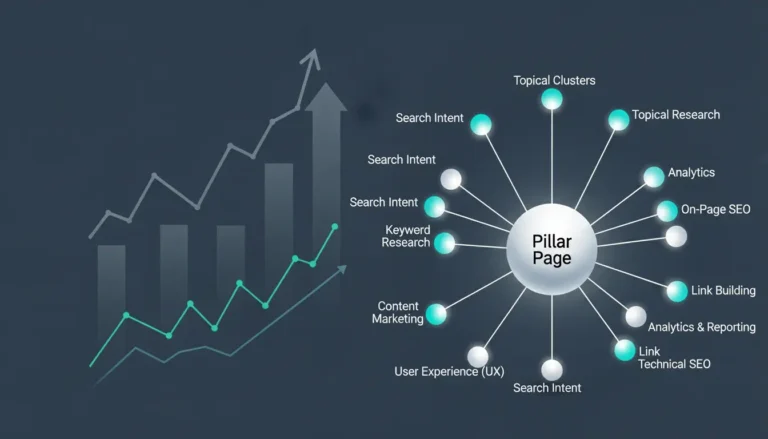
Content Clusters in SEO
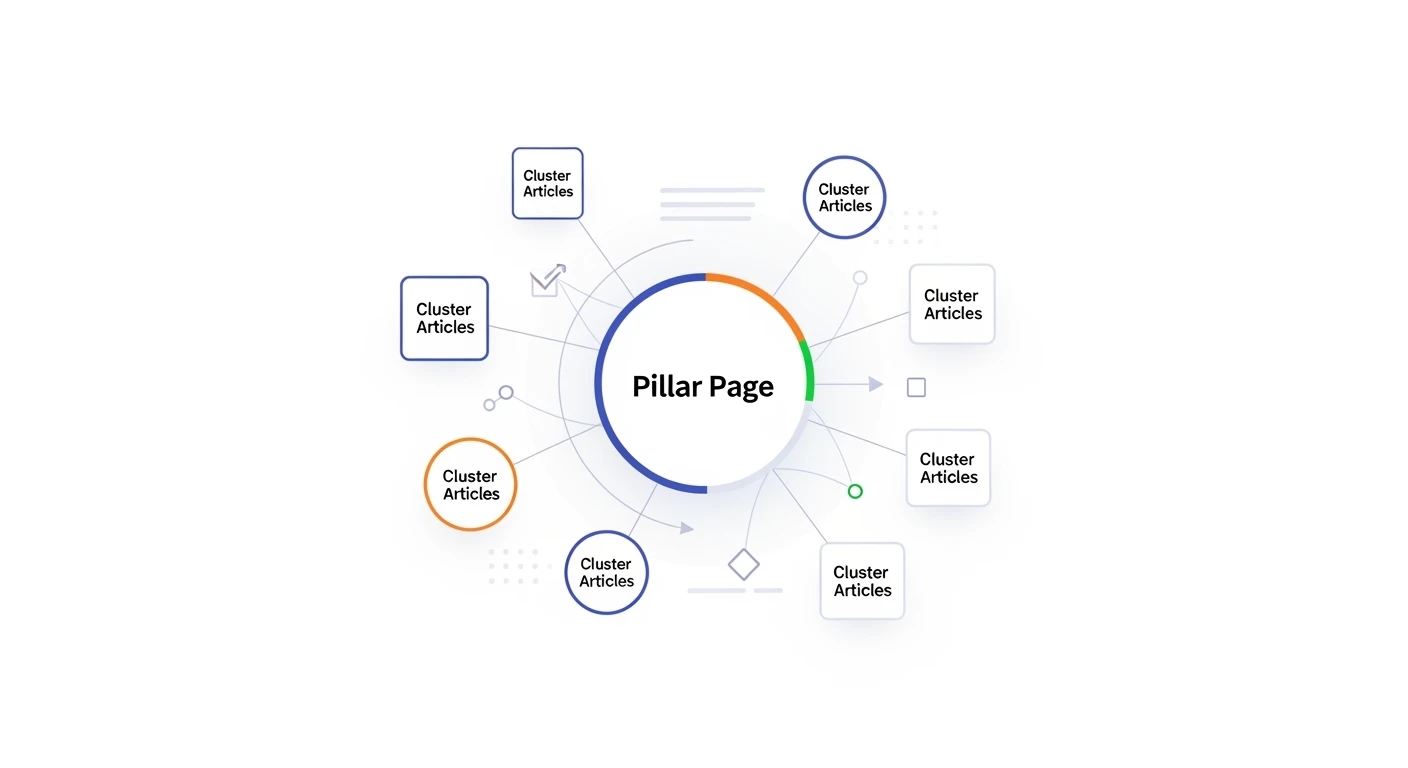
Content clusters in SEO are a content strategy where multiple related articles link back to one main “pillar” page to build topical authority.
This structure helps search engines clearly understand your expertise on a subject and improves rankings across many related keywords.
What Are Content Clusters in SEO?
Content clusters are a modern SEO framework used to organize website content around a central topic. Instead of publishing isolated blog posts targeting random keywords, the cluster model connects related articles under a single topic hub.
Think of it like a solar system.
At the center sits the pillar page. This is a comprehensive guide that broadly covers a topic.
Orbiting around it are cluster pages. These are more specific articles that dive deeper into individual subtopics.
Each cluster article links back to the pillar page. The pillar page also links to every cluster article. This internal linking structure signals to search engines that your site covers the topic in depth.
Example structure:
Pillar Page
“Complete Guide to Technical SEO”
Cluster Pages
• Website Crawlability
• XML Sitemaps Explained
• Robots.txt Optimization
• Fixing Indexing Issues
• Core Web Vitals Guide
Together, this structure builds strong topical relevance.
Search engines reward this clarity by ranking multiple pages from the same site for related queries.
Why Content Clusters Matter for SEO in 2026
Search engines no longer rank pages purely based on single keywords.
Modern algorithms evaluate topical depth and subject expertise.
A website with dozens of loosely connected posts struggles to compete with a site that demonstrates clear topical authority.
Content clusters solve this problem.
They organize your content so search engines can understand three key signals:
- Topical expertise
- Content relationships
- Internal authority flow
This becomes even more important in an AI-driven search environment where engines analyze semantic relationships between topics.
A well-built cluster does three powerful things:
- First, it helps search engines understand the context of your content.
- Second, it distributes internal link equity across related pages.
- Third, it improves user experience because readers can easily navigate deeper into related topics.
Instead of reading one article and leaving, visitors move through multiple pages within the cluster.
That increases engagement and session duration—two indirect signals that often correlate with better rankings.
The Core Components of a Content Cluster
A proper cluster structure has three fundamental elements.
1. The Pillar Page
The pillar page is the central resource covering a broad topic.
It provides an overview of the subject while linking to detailed cluster articles.
Characteristics of a strong pillar page:
- Comprehensive overview of the topic
- Long-form content (typically 2500+ words)
- Internal links to all cluster pages
- Optimized for a broad, high-volume keyword
Example pillar keyword:
“Content Marketing Strategy”
The page explains the entire concept but does not go extremely deep into each subtopic.
Instead, it links to supporting articles that expand on individual sections.
2. Cluster Pages
Cluster pages target specific subtopics related to the pillar.
Each article focuses on a narrow keyword or question.
Examples under a content marketing pillar:
How to Create a Content Calendar?
Content Distribution Strategies
Content Repurposing Guide
Content Marketing KPIs
Every cluster article links back to the pillar page.
This reinforces the relationship between the pages.
3. Internal Linking Structure
Internal links are what turn individual pages into a cluster.
Without linking, the structure does not exist in the eyes of search engines.
The linking pattern should follow this structure:
Cluster page → Pillar page
Pillar page → Cluster page
Cluster page → Related cluster page (optional but powerful)
This creates a strong internal web of relevance.
How Content Clusters Improve SEO Performance
The cluster model directly impacts multiple ranking factors.
Stronger Topical Authority
Search engines want to recommend sources that demonstrate expertise.
When your site contains dozens of articles about one subject, the algorithm begins to associate your domain with that topic.
This is known as topical authority.
Clusters accelerate this process.
Instead of spreading content across random keywords, every article reinforces the same subject.
Over time, your site becomes a trusted resource in that niche.
Better Internal Link Equity Distribution
Backlinks usually point to a few pages on a website.
Without a cluster structure, that authority stays isolated.
Clusters allow link equity to flow naturally between related pages.
For example:
If your pillar page earns backlinks, those signals pass through internal links to cluster articles.
As a result, even newer pages gain ranking power.
Improved Keyword Coverage
Clusters allow you to target hundreds of related keywords naturally.
Each cluster article ranks for its own keyword set.
Meanwhile, the pillar page captures broader search queries.
This creates a keyword ecosystem where multiple pages rank simultaneously.
Instead of competing against yourself, your pages support each other.
Higher Engagement and User Experience
Users rarely want just one answer.
They want a deeper understanding of a topic.
Clusters make this possible.
A reader landing on a pillar page can quickly explore related guides, tutorials, or case studies.
This creates a content journey rather than a single isolated article.
The result is longer sessions and more page views.
How to Build Content Clusters (Step-by-Step)
Creating clusters is a strategic process. It requires planning before writing content.
Step 1: Choose a Core Topic
Start by selecting a broad subject relevant to your niche.
This will become your pillar topic.
The topic should meet three conditions:
- Large search demand
- Enough subtopics to support multiple articles
- Strong relevance to your website’s niche
Examples:
SEO
Content marketing
Affiliate marketing
Email marketing
Link building
Avoid overly narrow topics because they cannot support many cluster articles.
Step 2: Identify Subtopics
Next, map out supporting topics.
These become cluster pages.
A simple method is to analyze:
- Search suggestions
- Related searches
- Competitor content structures
- Industry forums
Your goal is to identify questions, problems, and subthemes related to the main topic.
For example, if the pillar topic is “Technical SEO,” cluster topics might include:
Website indexing
Canonical tags
Crawl budget optimization
Structured data
Site architecture
Each one becomes a dedicated article.
Step 3: Create the Pillar Page First
The pillar page should serve as the central hub.
It should cover the topic broadly while introducing every subtopic.
Important elements include:
- Clear topic overview
- Table of contents
- Internal links to cluster pages
- Logical content sections
Do not try to turn the pillar page into a massive encyclopedia.
Instead, keep explanations concise and link to deeper articles.
Step 4: Publish Supporting Cluster Articles
Next, create detailed articles targeting each subtopic.
These should be optimized for long-tail keywords and search intent.
Every cluster article should:
- Answer a specific question
- Provide detailed guidance
- Link back to the pillar page
This internal linking is essential.
Without it, the cluster structure is incomplete.
Step 5: Build Internal Links Across the Cluster
After publishing several articles, strengthen the cluster by linking between related posts.
Example:
A guide about keyword research may link to an article about search intent.
This cross-linking strengthens topical relationships.
It also helps search engines crawl your site more efficiently.
Example of a Content Cluster Structure
To better understand the concept, imagine a website focused on SEO education.
Pillar Page
Complete Guide to SEO
Cluster Pages
Keyword Research Guide
On-Page SEO Optimization
Technical SEO Fundamentals
Link Building Strategies
SEO Analytics and Tracking
Each cluster article links to the pillar page and references related articles.
The result is a tightly connected topic ecosystem.
Common Mistakes When Building Content Clusters
Many websites attempt clusters but implement them incorrectly.
Here are common issues to avoid.
Publishing Random Content
Clusters require strategic planning.
Publishing unrelated articles weakens topical authority.
Every article should connect back to a central topic.
Ignoring Internal Links
Some websites publish cluster pages but forget to link them properly.
Without internal linking, search engines cannot understand the relationship between pages.
Overlapping Keyword Targeting
If multiple pages target the same keyword, they compete with each other.
Clusters should focus on distinct search intents.
Each article must have a unique purpose.
Weak Pillar Pages
A thin pillar page undermines the entire structure.
It must provide a strong overview of the topic and act as a reliable hub.
Content Clusters vs Traditional Blogging
Traditional blogging often focuses on individual posts targeting standalone keywords.
While this can work, it lacks structural cohesion.
Content clusters create a strategic content architecture.
Traditional approach
- Random posts
- Weak internal linking
- Limited topical authority
Cluster approach
- Structured topic coverage
- Strong internal linking
- Clear expertise signals
The difference becomes obvious over time.
Cluster-based sites tend to dominate entire topic areas rather than ranking for a few isolated keywords.
How AI Search Is Increasing the Importance of Clusters
Search engines are increasingly powered by artificial intelligence.
These systems analyze context, entities, and topic relationships rather than simple keyword matches.
Clusters help AI models understand:
- Topic depth
- Content relationships
- Author expertise
When an AI engine scans a site and finds dozens of well-linked articles about a single subject, it recognizes that site as a reliable source.
This increases the chances of appearing in AI-generated answers and knowledge summaries.
In the future, topic coverage may matter more than individual page optimization.
Clusters prepare your site for that shift.
Best Practices for High-Performing Content Clusters
Follow these practices to maximize SEO results.
- Focus on one topic at a time
- Create at least 8–12 cluster articles per pillar
- Update pillar pages regularly
- Add contextual internal links
- Use consistent anchor text
Another effective tactic is expanding clusters gradually.
Start with a pillar page and five cluster articles.
Then add new supporting content over time.
This steady expansion strengthens your topical authority.
Measuring the Success of Content Clusters
Tracking performance helps you understand whether your clusters are working.
Key metrics include:
- Keyword rankings across cluster topics
- Organic traffic growth
- Internal click-through rates
- Average session duration
A successful cluster often produces a noticeable pattern.
Instead of a single page driving traffic, multiple articles start ranking simultaneously.
Over time, the entire topic section of your site grows.
This is a clear signal that the cluster structure is working.
Final Thoughts
Content clusters transform scattered blog posts into a structured knowledge system that search engines can easily understand.
By connecting pillar pages and cluster articles through strategic internal links, websites build topical authority, improve rankings, and capture traffic across hundreds of related keywords.
As search algorithms become more focused on expertise and context, structured content ecosystems will outperform isolated posts.
Websites that invest in cluster strategies today position themselves as authoritative sources tomorrow.

Senior SEO Analyst with 5+ years experience. I specialize in Local SEO, Technical SEO, and AI search visibility through AEO and GEO strategies. Everything I write is tested against real search performance, not borrowed from someone else’s playbook.