The Ultimate SEO Checklist 2026 for Higher Rankings
Most websites don’t fail at SEO because of one big mistake. They fail because of dozens of small things that quietly break rankings.
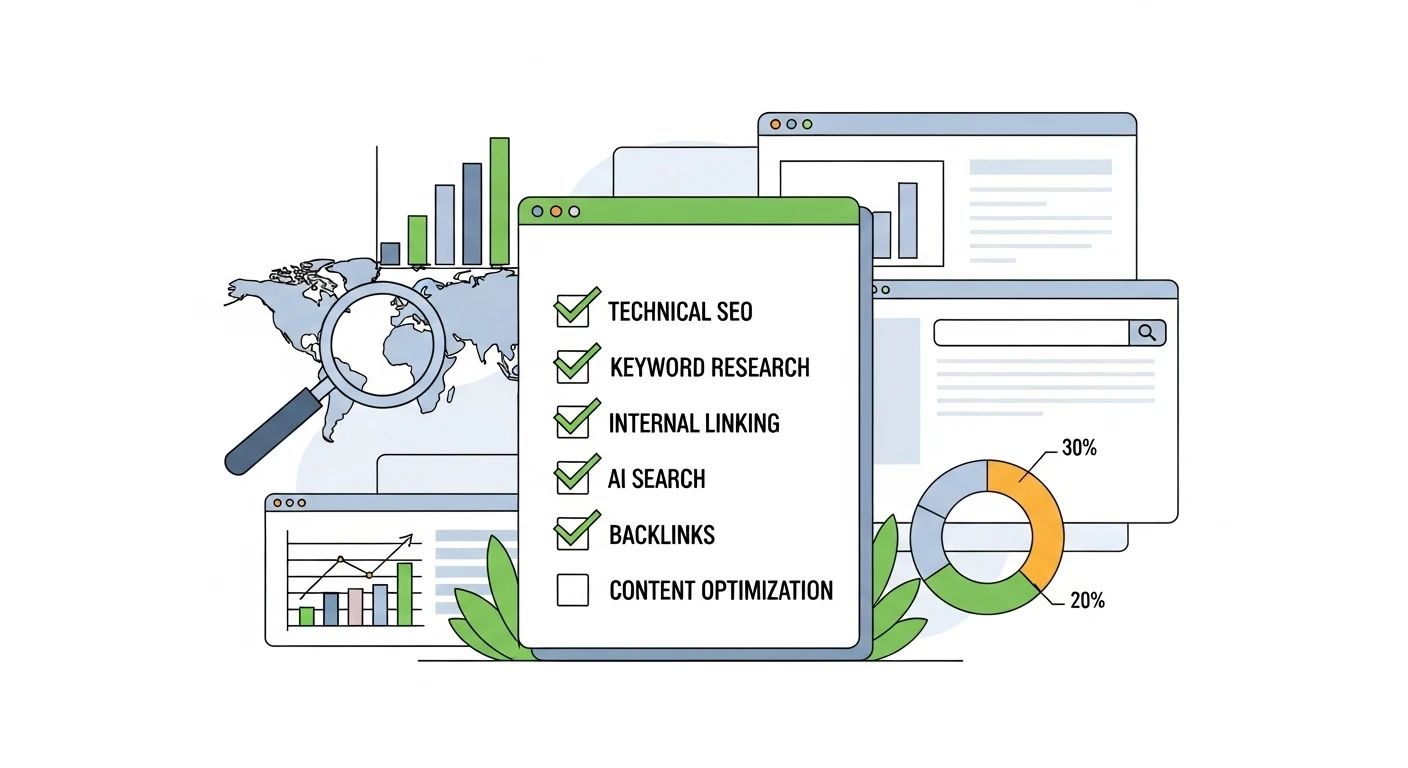
This Ultimate SEO Checklist for 2026 walks you through the exact actions that improve search visibility, AI search mentions, and long-term organic traffic.
SEO in 2026 is no longer about just adding keywords and building links. Search engines now analyze topical authority, content depth, site architecture, user signals, and AI-readable structure. If your site misses even a few of these elements, rankings drop.
This checklist covers everything from technical SEO and content optimization to internal linking, E-E-A-T signals, and AI search readiness.
Use it as a step-by-step framework to audit and improve your website.
Why SEO Checklists Still Matter in 2026
Search algorithms have become extremely sophisticated.
Modern ranking systems analyze:
- topic authority
- content structure
- search intent alignment
- user engagement signals
- entity relationships
- technical health
Because of this complexity, even experienced SEO professionals miss important steps.
A structured checklist prevents those gaps.
Instead of guessing what might be wrong with your site, you can systematically verify each ranking factor.
And when all these elements work together, rankings become much easier to achieve.
Technical SEO Checklist
Technical SEO is the foundation of your entire website. If search engines cannot crawl, index, and understand your pages properly, even great content will struggle to rank.
Start with these technical checks.
1. Ensure Proper Website Indexing
First, verify that search engines can actually index your pages.
Open your search console and check:
- indexed pages
- excluded pages
- crawl errors
- coverage reports
If important pages are excluded from indexing, investigate immediately.
Common causes include:
- incorrect robots.txt rules
- noindex tags
- canonical tag errors
- redirect loops
Fixing these issues can quickly improve visibility.
2. Optimize Website Speed
Page speed is now a major ranking factor because it directly impacts user experience.
Slow pages increase bounce rates and reduce engagement signals.
Focus on these optimizations:
- compress images
- enable browser caching
- reduce JavaScript
- use a CDN (how CDN works?)
- optimize server response time
Fast websites not only rank better but also convert more visitors.
3. Ensure Mobile Optimization
Most searches now happen on mobile devices.
Google uses mobile-first indexing, meaning the mobile version of your website is the primary version used for ranking.
Check:
- responsive design
- mobile page speed
- readable text sizes
- clickable elements spacing
A poor mobile experience can destroy rankings.
4. Fix Broken Links
Broken links create poor user experiences and disrupt crawling.
Use SEO tools to identify:
- 404 pages
- broken internal links
- broken external links
Fix them by updating URLs or redirecting outdated pages.
5. Implement Structured Data
Structured data helps search engines understand your content better.
It also improves your chances of appearing in:
- rich results
- knowledge panels
- AI summaries
Common schema types include:
- Article
- FAQ
- Product
- Review
- Organization
Schema markup strengthens content context and improves visibility.
Keyword Research Checklist
Keyword research in 2026 has evolved beyond simple search volume metrics.
Instead of focusing only on keywords, modern SEO focuses on search intent and topical coverage.
1. Identify Search Intent
Every keyword belongs to one of four intents:
- informational
- navigational
- transactional
- commercial
Your content must match the dominant intent.
For example:
A keyword like “best SEO tools” requires comparison content.
While “what is SEO” requires educational content.
If intent mismatches, rankings become almost impossible.
2. Focus on Topic Clusters
Instead of targeting isolated keywords, build topic clusters.
A topic cluster includes:
- one pillar page
- multiple supporting articles
- strong internal linking
For example:
Pillar topic: SEO Guide
Cluster topics:
- keyword research
- internal linking
- on-page SEO
- technical SEO
- link building
This structure helps search engines understand topical authority.
3. Analyze SERP Competitors
Before writing content, analyze the current top-ranking pages.
Study:
- content length
- headings
- questions answered
- media usage
- internal linking
Your content must provide more value than the existing results.
Otherwise ranking will be difficult.
4. Target Long-Tail Keywords
Long-tail keywords usually have lower competition and clearer intent.
Examples:
Instead of targeting
SEO tools
Target
best free SEO tools for beginners
These keywords often convert better and rank faster.
On-Page SEO Checklist
On-page SEO helps search engines understand exactly what your page is about.
It also improves readability and engagement.
1. Optimize Title Tags
Your title tag is one of the most powerful ranking signals.
Best practices include:
- keep titles under 60 characters
- include the primary keyword
- make it compelling for clicks
Example:
The Ultimate SEO Checklist for 2026
2. Write Strong Meta Descriptions
Meta descriptions do not directly affect rankings, but they influence click-through rate.
A good description should:
- summarize the page
- include keywords
- create curiosity
Higher CTR often leads to better rankings.
3. Use Proper Heading Structure
Headings improve readability and SEO.
Use hierarchy correctly:
H1 – page title
H2 – main sections
H3 – subsections
This helps both users and search engines understand your content structure.
4. Optimize Images
Images improve engagement but must be optimized.
Best practices:
- compress image sizes
- add descriptive alt text
- use relevant filenames
This also helps images appear in image search results.
5. Improve Content Readability
Readable content keeps users on the page longer.
Focus on:
- short paragraphs
- clear headings
- bullet lists
- simple language
User engagement signals strongly influence rankings.
Content Quality Checklist
Content remains the most powerful ranking factor.
But quality standards have increased dramatically.
1. Demonstrate E-E-A-T
Search engines evaluate:
Experience
Expertise
Authoritativeness
Trustworthiness
To strengthen E-E-A-T:
- include author information
- cite credible sources
- publish original insights
- update content regularly
This is especially important for competitive niches.
2. Cover Topics Deeply
Thin content no longer ranks.
Instead of writing short posts targeting one keyword, create comprehensive resources.
Your content should answer:
- what
- why
- how
- when
- common problems
- expert tips
Depth signals authority.
3. Use Visual Content
Visuals increase engagement and improve comprehension.
Include:
- screenshots
- diagrams
- infographics
- charts
These elements also increase shareability.
4. Update Old Content
Content freshness matters.
Regularly update posts by:
- adding new information
- improving examples
- updating statistics
- expanding sections
Updating old content often produces faster ranking improvements than publishing new posts.
Internal Linking Checklist
Internal links help distribute authority across your website.
They also help search engines discover new pages.
1. Link Related Pages
Every article should link to other relevant content.
Example:
If you publish a guide about technical SEO, link to articles about:
- page speed optimization
- crawl budget
- indexing issues
This strengthens topic relationships.
2. Use Descriptive Anchor Text
Anchor text tells search engines what the linked page is about.
Avoid generic anchors like:
click here
Instead use descriptive phrases such as:
technical SEO checklist
3. Fix Orphan Pages
Orphan pages are pages with no internal links pointing to them.
These pages are difficult for search engines to discover.
Run regular audits to identify and fix orphan pages.
Link Building Checklist
Backlinks remain one of the strongest ranking factors.
However, quality matters far more than quantity.
1. Earn Relevant Backlinks
Links from relevant websites carry more weight.
Focus on:
- industry blogs
- niche publications
- expert interviews
- data studies
Relevance improves link value.
2. Create Linkable Assets
Certain types of content attract links naturally.
Examples include:
- original research
- statistics pages
- industry reports
- ultimate guides
- tools
These assets become natural link magnets.
3. Use Digital PR
Digital PR is becoming a powerful link building strategy.
Examples include:
- expert quotes
- data reports
- journalist outreach
- industry insights
This approach earns authoritative mentions.
AI Search Optimization Checklist
AI-driven search is changing how content appears in results.
Search engines now generate answers directly using multiple sources.
To improve visibility in AI search:
1. Write Clear, Structured Content
AI systems prefer structured information.
Use:
- clear headings
- short explanations
- step-by-step sections
This makes your content easier to extract.
2. Answer Questions Directly
Many AI answers come from pages that clearly answer questions.
Include sections that directly address:
- common questions
- definitions
- quick explanations
3. Build Brand Mentions
AI models rely heavily on entity recognition.
Brands mentioned frequently across trusted websites have higher visibility.
Focus on building mentions through:
- PR
- partnerships
- collaborations
- expert contributions
User Experience Checklist
User behavior signals now play a stronger role in rankings.
Search engines measure how users interact with your content.
1. Reduce Bounce Rates
High bounce rates signal poor relevance.
Improve engagement by:
- matching search intent
- improving page design
- writing strong introductions
2. Increase Time on Page
Visitors should spend time reading your content.
Use:
- storytelling
- clear formatting
- engaging visuals
3. Improve Navigation
Users should easily find related information.
Good navigation includes:
- clear menus
- related posts
- internal links
- search functionality
Better navigation improves engagement metrics.
Analytics and Tracking Checklist
SEO without measurement is guesswork.
You need clear data to understand what works.
1. Monitor Keyword Rankings
Track how your target keywords perform over time.
Ranking improvements often indicate successful optimization.
2. Analyze Organic Traffic
Use analytics tools to monitor:
- traffic growth
- top pages
- entry pages
- user behavior
These insights guide future improvements.
3. Track Conversion Metrics
Traffic alone is not enough.
Measure conversions such as:
- sign-ups
- downloads
- purchases
- inquiries
SEO success should ultimately support business goals.
Final Thoughts
SEO success in 2026 comes from combining multiple strategies rather than relying on a single tactic.
Technical health, content depth, topical authority, internal linking, and brand credibility all work together to influence rankings.
By following this Ultimate SEO Checklist, you ensure that every major ranking factor is covered.
Instead of chasing algorithms, you create a website that search engines naturally trust and users genuinely find helpful.
When these two elements align, consistent organic traffic becomes inevitable.

Senior SEO Analyst with 5+ years experience. I specialize in Local SEO, Technical SEO, and AI search visibility through AEO and GEO strategies. Everything I write is tested against real search performance, not borrowed from someone else’s playbook.