The Ultimate Step-by-Step Guide to Implementing a B2B SEO Strategy 2026
Most B2B websites struggle with SEO because they chase traffic instead of qualified leads. The real goal of B2B SEO is not rankings alone — it is attracting decision-makers who are actively looking for solutions.
This complete B2B SEO strategy explains how to build organic visibility that drives high-value leads, long sales conversations, and sustainable growth. If implemented correctly, B2B SEO becomes one of the most reliable channels for generating consistent pipeline opportunities.
B2B search behavior is very different from B2C. Buyers research deeply, compare vendors, and often involve multiple stakeholders before making a decision. Because of this, B2B SEO requires a structured strategy that aligns with long buying cycles, informational content, and authority building.
This guide walks through the entire B2B SEO framework used by successful companies in 2026.
What is B2B SEO?
B2B SEO refers to the process of optimizing a website so businesses searching for professional products or services can discover it through search engines.
Unlike consumer SEO, B2B optimization focuses on attracting business decision makers such as:
- founders
- marketing managers
- procurement teams
- product leaders
- executives
These users search for solutions that help their organizations operate better, increase revenue, or reduce operational costs.
For example, a B2B SaaS company might target queries like:
- marketing automation platform
- CRM software comparison
- enterprise analytics tools
Each of these searches represents a potential customer researching software for their organization.
Because these purchases are expensive and complex, B2B SEO focuses heavily on education, trust, and authority.
Why B2B SEO Matters More Than Ever
Many companies still rely heavily on paid advertising and outbound sales.
But organic search has become one of the most powerful acquisition channels for B2B companies.
Here is why.
Buyers Start With Search
Most B2B buying journeys begin with research.
Decision makers search for:
- solutions
- comparisons
- reviews
- case studies
- pricing information
If your company does not appear during this research phase, you lose potential customers before the conversation even begins.
Organic Traffic Compounds Over Time
Unlike ads, SEO continues generating traffic long after content is published.
A well-optimized guide can generate leads for years.
This makes SEO one of the most cost-efficient acquisition channels in the long run.
SEO Builds Trust and Authority
High-ranking content signals credibility.
When potential buyers repeatedly see your brand while researching industry topics, your company becomes associated with expertise.
This trust significantly improves conversion rates later in the sales process.
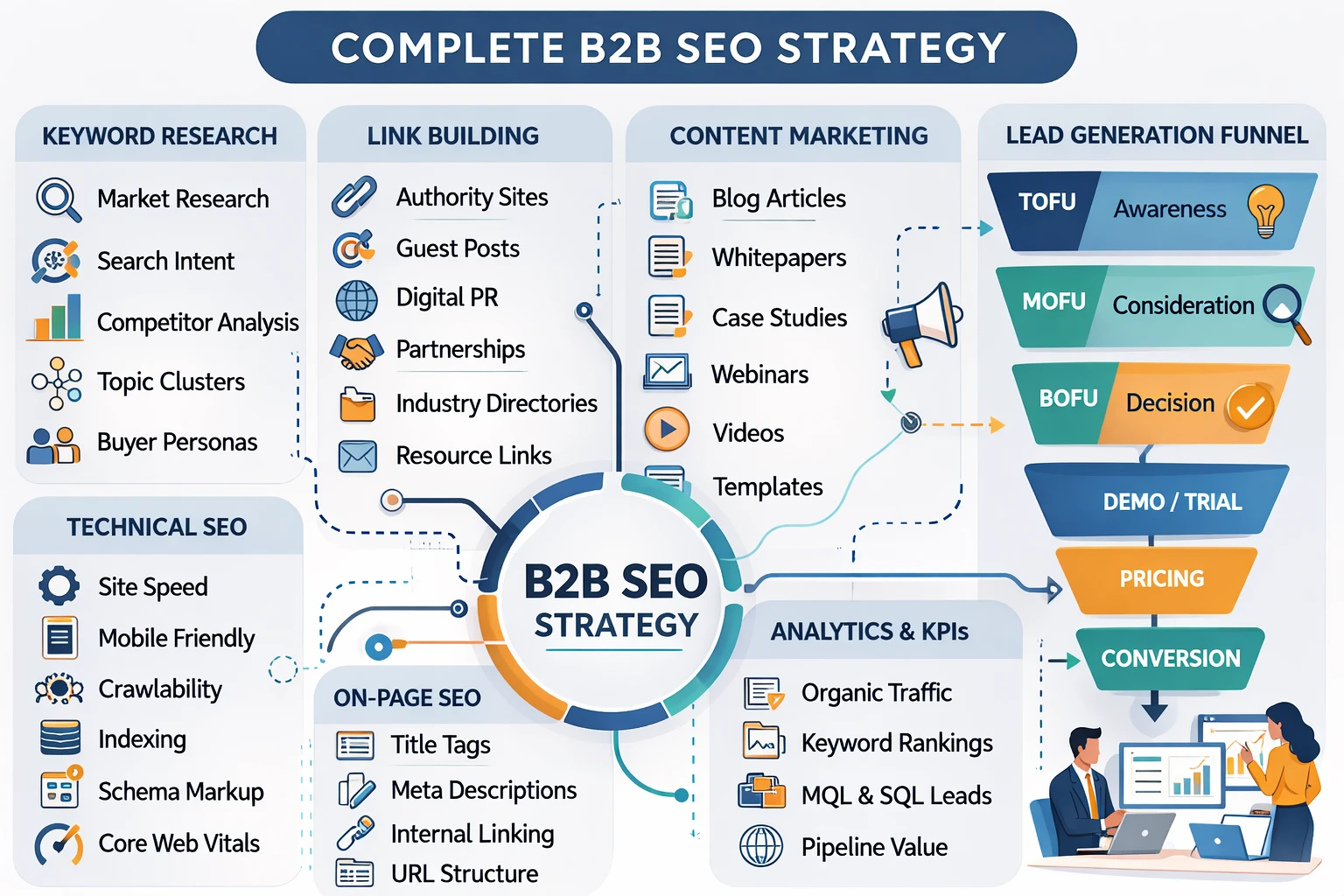
Understanding the B2B Search Funnel
One of the biggest mistakes in B2B SEO is targeting only bottom-of-funnel keywords.
Successful strategies cover the entire buyer journey.
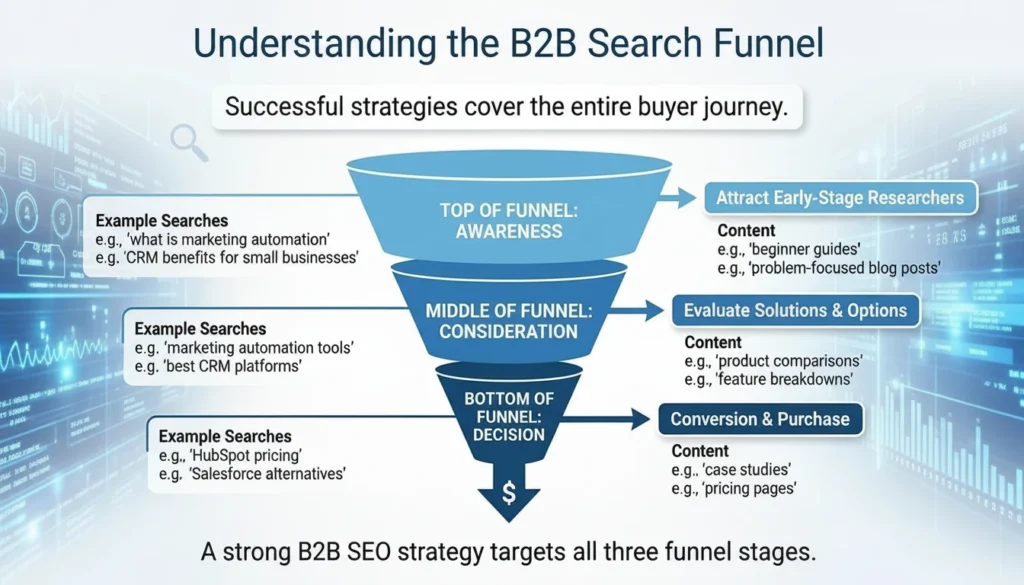
Top of Funnel: Awareness
At this stage, buyers are researching problems.
Example searches include:
- what is marketing automation
- how to improve sales pipeline
- CRM benefits for small businesses
Content at this stage should focus on education.
Examples:
- beginner guides
- industry explanations
- problem-focused blog posts
The goal is to attract early-stage researchers.
Middle of Funnel: Consideration
Buyers now understand their problem and start exploring solutions.
Example searches include:
- marketing automation tools
- best CRM platforms
- email marketing software comparison
Content here should help users evaluate options.
Examples include:
- product comparisons
- solution guides
- feature breakdowns
Bottom of Funnel: Decision
At this stage, buyers are close to purchasing.
Example searches include:
- HubSpot pricing
- Salesforce alternatives
- best CRM for SaaS companies
Content here focuses on conversion.
Examples include:
- case studies
- product pages
- pricing pages
- implementation guides
A strong B2B SEO strategy targets all three funnel stages.
B2B Keyword Research Strategy
Keyword research for B2B websites requires a different approach compared to traditional SEO.
Instead of chasing high search volume, focus on intent and relevance.
Identify Problem-Based Keywords
Many B2B buyers search for problems rather than products.
Examples include:
- improve sales forecasting
- automate marketing campaigns
- reduce customer churn
These queries represent real pain points.
Content addressing these problems often attracts high-quality prospects.
Target Solution Keywords
Solution keywords describe the type of product users want.
Examples include:
- marketing automation software
- CRM platform for startups
- customer analytics tools
These keywords attract users actively exploring solutions.
Focus on Comparison Keywords
Comparison keywords are extremely valuable in B2B SEO.
Examples include:
- HubSpot vs Salesforce
- best marketing automation platforms
- CRM alternatives
Users searching these terms are evaluating vendors and are closer to making decisions.
Use Long-Tail Queries
Long-tail keywords often represent highly specific business needs.
Examples include:
- CRM software for real estate agencies
- marketing automation for ecommerce brands
These keywords may have lower search volume but significantly higher conversion potential.
Building a B2B Content Strategy
Content is the engine behind B2B SEO success.
But random blog posts rarely work.
Instead, build structured topic ecosystems.
Create Pillar Pages
A pillar page is a comprehensive resource covering a broad topic.
Example pillar topics include:
- marketing automation guide
- CRM software guide
- B2B lead generation strategies
These pages serve as central hubs for related content.
Develop Topic Clusters
Each pillar page should connect to multiple supporting articles.
Example cluster topics for a CRM pillar might include:
- CRM implementation guide
- CRM benefits for startups
- CRM data management tips
- CRM integration strategies
Internal linking between these pages strengthens topical authority.
Publish Decision-Stage Content
Most B2B companies lack strong decision-stage content.
Create pages such as:
- product comparison pages
- feature breakdowns
- alternatives pages
- pricing explanations
These pages directly influence purchase decisions.
Use Case Studies
Case studies are powerful B2B assets.
They demonstrate real results and build credibility.
Effective case studies include:
- problem description
- solution implementation
- measurable results
This content reassures potential buyers that your solution works.
On-Page SEO for B2B Websites
Optimizing pages properly ensures search engines understand your content.
Optimize Title Tags
Title tags should clearly describe the page while including the primary keyword.
Example:
Marketing Automation Software: Complete Guide for B2B Teams
Clear titles improve both rankings and click-through rates.
Structure Content Clearly
Use headings to organize information logically.
Typical structure:
H1 – main topic
H2 – major sections
H3 – supporting details
Structured content is easier for both readers and search engines to understand.
Improve Content Depth
B2B buyers perform detailed research.
Content should cover:
- definitions
- benefits
- implementation strategies
- tools
- examples
- challenges
Comprehensive content performs better in search results.
Optimize Internal Links
Internal linking connects related pages and distributes authority across your site.
For example:
A guide about lead generation should link to:
- landing page optimization
- email marketing strategies
- conversion rate optimization
These connections help search engines understand topic relationships.
Technical SEO for B2B Sites
Technical SEO ensures your website functions efficiently.
Improve Page Speed
Fast websites improve user experience and rankings.
Focus on:
- image compression
- script optimization
- caching
- CDN usage
Ensure Mobile Optimization
Many B2B buyers research solutions on mobile devices.
Your website must provide:
- responsive design
- readable text
- easy navigation
Optimize Website Architecture
A clear site structure improves crawlability.
Example structure:
Homepage
–Services or Products
–Industry Solutions
–Resources or Blog
–Case Studies
–Contact Page
Logical architecture helps search engines understand content hierarchy.
Fix Indexing Issues
Regularly check for:
- crawl errors
- duplicate content
- broken links
- redirect chains
Resolving these issues improves site performance.
Link Building for B2B SEO
Backlinks remain a critical ranking factor.
However, B2B link building should focus on authority and relevance.
Publish Original Research
Data-driven reports attract links from industry publications.
Examples include:
- industry benchmarks
- market analysis reports
- annual trend studies
These assets naturally generate citations.
Guest Posting
Writing articles for industry blogs exposes your brand to new audiences.
Guest posts also generate high-quality backlinks.
Digital PR
Digital PR helps earn mentions in media outlets.
Examples include:
- expert commentary
- industry insights
- survey reports
These mentions strengthen brand authority.
Partnerships
Collaborating with other companies often leads to mutual content promotion and backlinks.
Examples include:
- webinars
- co-authored research
- joint case studies
Partnerships expand reach and credibility.
Optimizing for B2B Lead Generation
Traffic alone is not enough.
Your SEO strategy must convert visitors into leads.
Create Strong Lead Magnets
Lead magnets encourage visitors to share their contact information.
Examples include:
- whitepapers
- industry reports
- templates
- strategy guides
These assets provide value while capturing leads.
Optimize Landing Pages
Landing pages should focus on one clear objective.
Best practices include:
- clear messaging
- strong value proposition
- concise forms
- trust signals
Well-optimized landing pages significantly improve conversions.
Use Calls to Action
Every page should guide users toward the next step.
Examples include:
- book a demo
- download the guide
- request a consultation
Clear calls to action move users through the funnel.
Measuring B2B SEO Success
Tracking the right metrics ensures your strategy stays effective.
Organic Traffic Growth
Monitor how organic traffic changes over time.
Increasing traffic often indicates improving visibility.
Keyword Rankings
Track the positions of important keywords related to your products and services.
Improved rankings signal stronger search presence.
Lead Generation
Measure how many leads originate from organic search.
This metric connects SEO directly to revenue.
Conversion Rate
Evaluate how effectively visitors become leads or customers.
Optimizing conversion rates improves ROI without increasing traffic.
Customer Acquisition Cost
SEO often reduces acquisition costs compared to paid channels.
Lower costs improve overall marketing efficiency.
Common B2B SEO Mistakes
Avoiding common mistakes can save significant time and resources.
Ignoring Search Intent
If content does not match user intent, rankings will struggle regardless of optimization.
Targeting Only High-Volume Keywords
High-volume terms often attract irrelevant traffic.
Intent-focused keywords perform better.
Publishing Thin Content
Short, shallow content rarely ranks in competitive B2B industries.
Depth and expertise are essential.
Weak Internal Linking
Without strong internal links, search engines cannot understand topic relationships.
Neglecting Decision Content
Many companies produce educational content but ignore conversion-stage pages.
Both are necessary for a complete strategy.
The Future of B2B SEO
Search is evolving rapidly due to AI-driven engines and conversational search.
Future B2B SEO strategies will emphasize:
- deeper expertise
- brand authority
- structured information
- trustworthy sources
- strong entity signals
Companies that invest in educational, authoritative content will dominate search visibility.
Final Thoughts
B2B SEO is not about quick wins. It is about building long-term authority that consistently attracts high-value prospects.
By focusing on search intent, topic authority, high-quality content, and strong technical foundations, companies can transform organic search into a predictable lead generation engine.
When executed properly, B2B SEO does more than drive traffic. It places your brand in front of decision makers exactly when they are researching solutions.
That visibility often determines which companies win the deal.

Senior SEO Analyst with 5+ years experience. I specialize in Local SEO, Technical SEO, and AI search visibility through AEO and GEO strategies. Everything I write is tested against real search performance, not borrowed from someone else’s playbook.